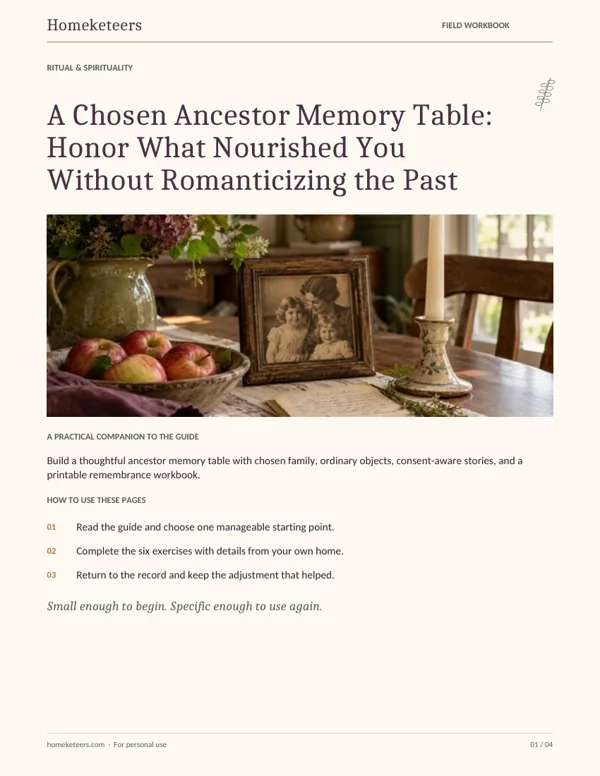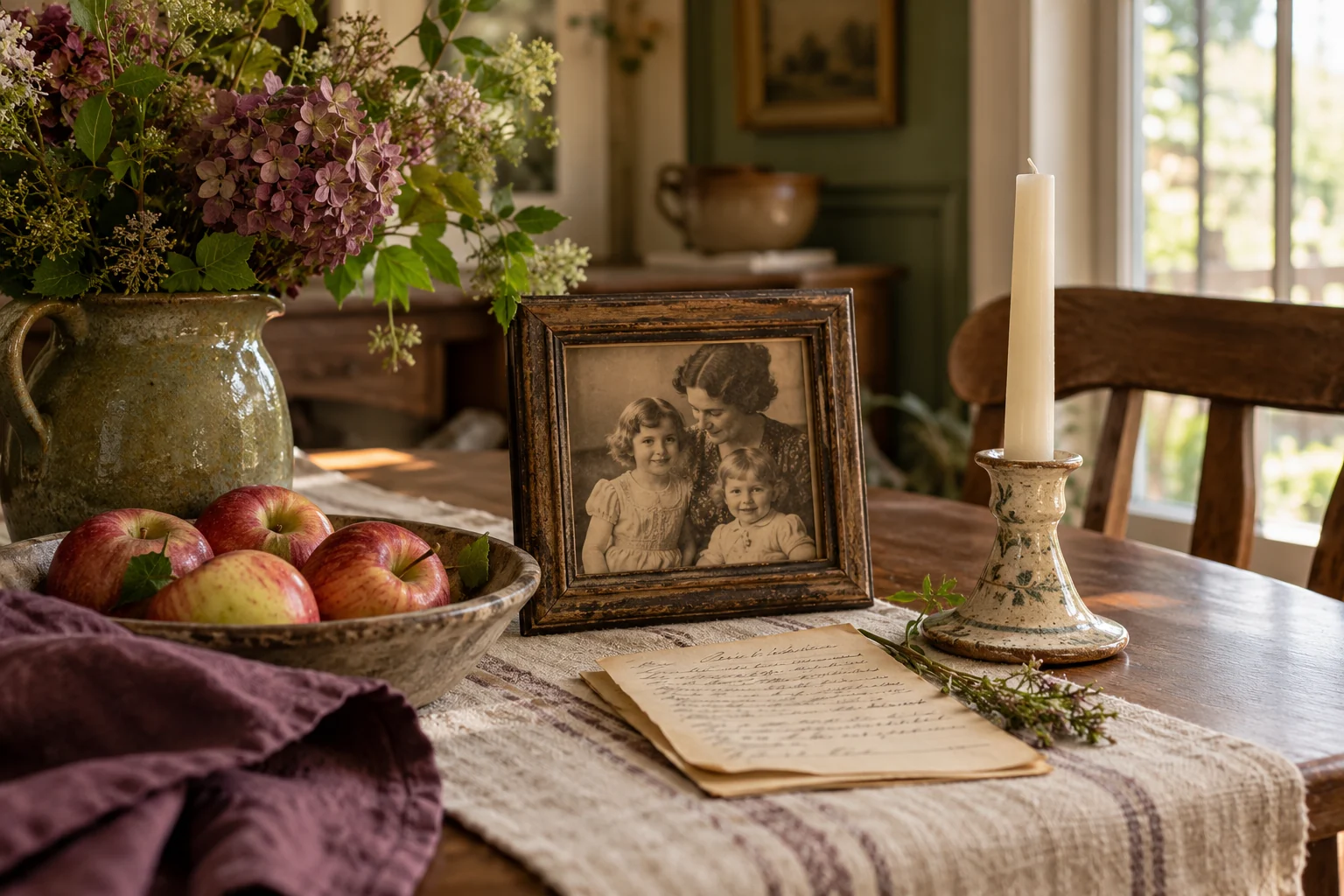
Remembrance does not require pretending every family relationship was loving. A meaningful ancestor table can honor nourishment, acknowledge complexity, and leave some stories outside the room. You can include biological relatives, chosen family, teachers, community elders, or people whose work shaped your life. You are deciding what deserves a place in this particular act of memory.
The Homeketeers Chosen Ancestor Table is a personal remembrance practice, not a claim to reproduce a specific culture's sacred tradition. If you belong to a tradition with its own practices, follow the knowledge and permissions appropriate to that community. This guide offers an ordinary home table built from photographs, objects, written memories, and boundaries. It does not promise communication with the dead or require anyone else to accept your beliefs.
Choose the purpose before the objects
Write what you want the table to hold: gratitude for a skill, a memory of care, a family recipe, or recognition of someone who made room for you. Avoid a broad requirement to honor everybody. A table with one meaningful object can be more honest than an elaborate display assembled from obligation.
Decide who will see it. A private bedside shelf permits different material from a shared family table. Children and other household members should not be required to participate, disclose personal memories, or look at a photograph that makes them uncomfortable. Ask before using another person's keepsake. Ownership of an object and permission to display its story are separate questions.
Gather three kinds of evidence
Choose one image or written name, one everyday object, and one specific memory. The object might be a sewing tool, a recipe card, a garden label, or a book. Use copies of fragile originals where practical. Keep food, liquids, heat, and direct sunlight away from materials that could be damaged. A battery light can provide atmosphere without putting a photograph beside a flame.
Write the memory as a scene: where you were, what the person did, and why that action mattered. 'She always loved us' may be true, but 'she saved the crisp edge of the bread for me' gives the remembrance a particular shape. You do not need to turn the scene into a lesson for everyone who sees it.
Keep complexity on its own page
A person may have taught you something valuable and also caused harm. You can acknowledge the valuable contribution without excusing the harm. If writing the complexity helps, use a private page rather than placing sensitive details on a shared display. You can also choose not to include the person at all. Remembrance is not a public trial, and exclusion from one table is not a claim to erase history.
For a child, use simple honest language: 'We are remembering this recipe and the time we cooked together. Other parts of the relationship were difficult.' Do not recruit the child to judge adult conflicts or comfort the adult. The table can stay focused on one safe memory while more complicated conversations happen in an appropriate setting.
Make a brief act of remembrance
Arrange the objects with enough empty space to see each one. Read the memory aloud or silently. Name the contribution you want to carry forward: patience in teaching, a practical skill, generosity with food, or willingness to welcome someone. Choose one ordinary act that embodies it. Cook the recipe, repair a garment, tell a permitted story, or write to a living person who offered similar care.
An illustrative example: a woman places a copied recipe card beside her aunt's wooden spoon. The aunt was not perfect, and the wider family history is complicated. The chosen memory is that the aunt made room for a child to help without being scolded for spilling flour. The woman plans a small baking session with her own child, using the same patient invitation.
Allow chosen family to belong
If biological family is unavailable, estranged, unknown, or simply not the focus, use a person who genuinely shaped your life. A neighbor, friend, teacher, or mentor can be named. You do not need to manufacture a lineage story to make a meaningful table. Record how the person influenced you and which part you are choosing to continue.
If the person is living, ask before sharing a sensitive photograph or story. A private remembrance can still affect someone when it is photographed and posted. Decide separately whether the table remains in the home, can be shown to visitors, or may be shared online. A warm intention does not remove the need for permission.
Close the display with care
Choose an ending date or review date. Put original objects back in suitable storage and keep the written memory if you want. A seasonal table does not need to become a permanent shrine. If the display feels burdensome, simplify or close it. There is no requirement to maintain an arrangement to prove love.
Carry the useful contribution into one real action. That gives remembrance a place in the living household. The table becomes a way to select what you will continue, while keeping the right to name limits and leave other parts of the past outside this practice.
Your Homeketeers field workbook: put this guide into practice
The Chosen Ancestor workbook keeps public display, private memory, and practical continuation on separate pages. Use names or descriptions that feel appropriate. The permission panel helps you decide what can be displayed or shared. You can complete the workbook with one chosen person or contribution; an extensive family tree is not required.
The person or contribution you choose
Write the name, relationship, or role and the specific contribution you want to remember. Chosen family belongs here without an explanation of why biological relatives are absent. Record why this memory fits the present moment. If the purpose is unclear, begin with one scene of care or one skill you still use, rather than filling the table with every available photograph.
The object and its condition
Describe the object, who owns it, and whether a copy would be safer. Note fragile paper, sentimental value, moisture, light, and heat. Choose a stable location away from spills and small children who could damage or swallow an item. A photograph of an object can stand in for the original. The memory does not depend on risking something irreplaceable.
A specific remembered scene
Write where the scene happened, what the person did, and what you remember sensing. Separate what you witnessed from details another person later told you. If the date is uncertain, say so. Do not improve the story merely to make it more uplifting. A small accurate scene is enough to give the table meaning and preserve something recognizable.
What stays private or outside the table
Name a boundary for stories, photographs, or relationships. You can use a private notebook without displaying its contents. Ask household members whether a shared object or image is welcome. Do not require a child to explain a refusal in front of other relatives. The table's purpose is chosen remembrance, not compulsory participation or a complete account of family history.
Permission to display and share
Record the owner of each object and any permission needed from a living person pictured or described. Decide whether visitors may photograph the table and whether it may appear online. Keep that decision separate from permission to display it at home. If you do not have permission, choose a neutral object or your own written memory instead of assuming affection makes publication acceptable.
The contribution carried forward
Choose one action that expresses the selected quality: teach a skill patiently, cook a recipe, tend a plant, or make room for someone. Give it a date and a manageable size. Avoid a sweeping promise to live exactly as the remembered person did. You are continuing one worthwhile contribution in your own circumstances, not surrendering judgment about the rest of their life.
Keep a record that tells you what actually changed
When you close or renew the table, record what felt meaningful, what felt pressured, and which practical action you completed. Keep uncertainty visible in the written memory. Return borrowed objects and store originals appropriately. If the arrangement raised a story someone did not want displayed, remove it and respect that limit. You can preserve a private note without publishing it. This Homeketeers practice treats remembrance as a choice about what to carry forward. It makes room for gratitude, chosen relationships, and complexity without requiring a polished family narrative or a belief everyone in the household must share.