A doorway is where the outside world meets the life you are responsible for inside. It is also where many boundaries become practical: who visits, what enters, when work ends, and whether you have time to pause before agreeing to another request. The Threshold Key Ritual uses an ordinary key as a physical reminder of a chosen boundary. Its power is symbolic and personal. The key does not change another person's behavior or provide physical protection by itself.
You will choose one boundary, express it in a sentence, and pair it with a repeatable action at the doorway. No smoke, purchased ingredients, or claim of spiritual superiority is needed. If ritual language speaks to you, use it. If it does not, the same practice can function as a deliberate transition into home. The useful question is whether the symbol helps you remember and carry out an action that matters.
Choose a boundary you control
Start with your own behavior: I will check my calendar before accepting visitors; I will put work messages aside during the supper window; I will ask people to arrange a visit instead of arriving unexpectedly. Avoid intentions that depend on controlling someone else, such as making a person apologize or preventing every disagreement. A ritual cannot make those outcomes yours to guarantee.
Write the boundary in ordinary language before writing any invocation. Name the situation, your action, and the practical limit. For visits, that might be: 'When someone asks to come over, I will check what the household needs before replying.' This leaves room for welcome while giving your needs a place in the decision. It is more usable than a general wish for protection.
Prepare a small, functional station
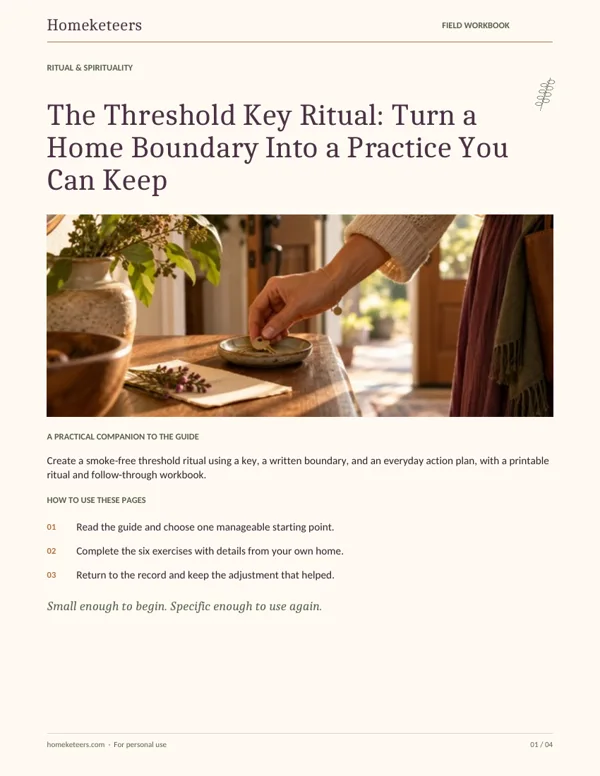
Use your normal key, a spare symbolic key, or a drawn key if you do not want to involve a working key. Add a stable dish and a small paper card. Place them where they will not obstruct the exit, confuse household access, or become accessible to a child who could swallow a small object. Keep functioning locks and emergency access exactly as they need to be.
Clean the dish with an ordinary suitable method and dry it. Clear enough space for the objects to sit securely. You do not need to energetically purify every item or decide that a difficult event contaminated the home. Practical cleaning is sufficient. The preparation marks attention to the chosen purpose, not a requirement for a spiritually spotless environment.
Speak the meaning and the action together
Hold or look at the key. Read your boundary sentence. Then add a symbolic line if desired: 'This threshold welcomes what we can carry with care. I keep the right to pause.' Say it once in a comfortable voice. You can remain silent, write the words, or invite a household member to witness without participating.
Place the key on the dish and the card beneath or beside it. Identify the next real action. If you need to change a visiting expectation, write the message yourself and choose when to send it. If the boundary is about work, set the available device setting or move the phone to the agreed place. The ritual is incomplete until the ordinary action has a clear destination.
Use the doorway as a short reminder
For seven days, pause briefly when the relevant situation arises. Touch the card or glance at the key, then use the planned action. Do not repeat the ritual every time you feel uneasy. A repeated ceremony can become more work than the boundary it was meant to support. One brief reminder is enough for this experiment.
An illustrative example: a mother agrees to last-minute visits because she dislikes disappointing people. She chooses a key card that says 'Check before inviting.' When a friend asks to stop by, she replies, 'I need to check our evening. I will let you know shortly.' After checking, she offers Saturday instead. Nothing supernatural needs to happen for the practice to matter; the pause changed the sequence.
Plan for a boundary being challenged
Prepare one calm repeat: 'Tonight does not work. Saturday is the time I can offer.' You do not need to explain the entire ritual or disclose private household circumstances. If a situation involves intimidation, unwanted entry, or danger, use appropriate practical safety steps and outside support. A symbolic station is not a replacement for those measures.
If you forget, record where the action became difficult. Was the card too hidden? Was the reply too elaborate? Was the boundary impossible during your work duties? Change the practical design rather than assuming you failed a spiritual test. The practice should make your chosen action easier to remember, not give you a new reason to criticize yourself.
End or renew deliberately
After seven days, review the boundary and the action. Keep the key station if it remains useful, rewrite the card if the limit changed, or put the objects away. You are allowed to complete a ritual without maintaining it indefinitely. The doorway remains a doorway. Your home remains worthy of care even on a day when you forgot the pause.
Your Homeketeers field workbook: put this guide into practice
The Threshold Key Fieldbook separates symbolic meaning from practical follow-through. Use the left side of each spread for your words and the right side for the action you can observe. Keep the ritual private if you prefer; the people affected by a boundary need the ordinary boundary statement, not access to your spiritual notebook.
The situation and chosen boundary
Describe one repeat situation in plain language. Identify what you can decide and what belongs to someone else. Write a sentence that starts with your own action, such as checking the calendar before replying. Remove promises of controlling another person. Record the practical reason for the boundary so it remains understandable when the initial emotion has passed.
The symbol and its safe location
Choose the key, dish, or drawing and record what the symbol means to you. Draw the station's position near the doorway. Check that it does not block movement or confuse access to a working key. Use a larger drawing rather than a small object where young children could reach it. Practical safety belongs inside the ritual's design.
Your words, without borrowed authority
Write a short invocation in your own language. You do not need to claim ancient origins or attach the practice to a tradition you do not know. Pair the symbolic line with the ordinary boundary sentence. Read both and remove words that imply guaranteed protection or control. The words should help you remember a chosen action, not promise an outcome beyond it.
The first real action
Name what will happen after the ceremony: change a device setting, write a visiting message, check a calendar, or move a work object. Put a date beside it and identify any dependency. If the action cannot happen now, schedule the smallest preparatory step. A useful ritual leaves a clear ordinary task, rather than only a feeling of completion.
The challenged-boundary reply
Prepare one short repeat and one feasible alternative if you want to offer it. Practice the wording aloud or write it several times. Do not invent an explanation you cannot sustain. If you are dealing with a dangerous or coercive situation, record the appropriate practical support separately. The key station can remain symbolic while real safety decisions receive their own attention.
Seven days of observation
Make one line for each relevant opportunity, rather than forcing an entry when nothing happened. Record the pause, reply, and next action. Include a forgotten pause without turning it into a character judgment. Note whether the station helped or merely added clutter. Keep the evidence small and specific so the review can change the practice intelligently.
Keep a record that tells you what actually changed
At the end of the week, compare the chosen action with what actually happened. Did you pause before replying? Did your alternative fit the household? Did the visible symbol help, or would a calendar note work better? Write a decision to keep, change, or complete the practice. Store the card with your notes if you put the key away. You can return to it when circumstances change without declaring the previous version wrong. This ritual is an original Homeketeers symbolic practice, designed to support ordinary boundaries. Its value comes from the meaning you give it and the action you carry into daily life.