
A chore chart can show who empties the dishwasher while leaving one person responsible for noticing the dishwasher is full, choosing when it runs, buying detergent, and reminding everyone. That invisible planning is work. A decision board makes the ownership visible before a task becomes urgent.
The useful principle behind the method
Shared responsibility does not mean every decision is a group vote. Safety, money, privacy, and adult commitments may stay with adults. Children can still contribute within a clear boundary: choose between two workable dinners, pick a packing order, or decide which shared room is reset first.
A complete process you can follow
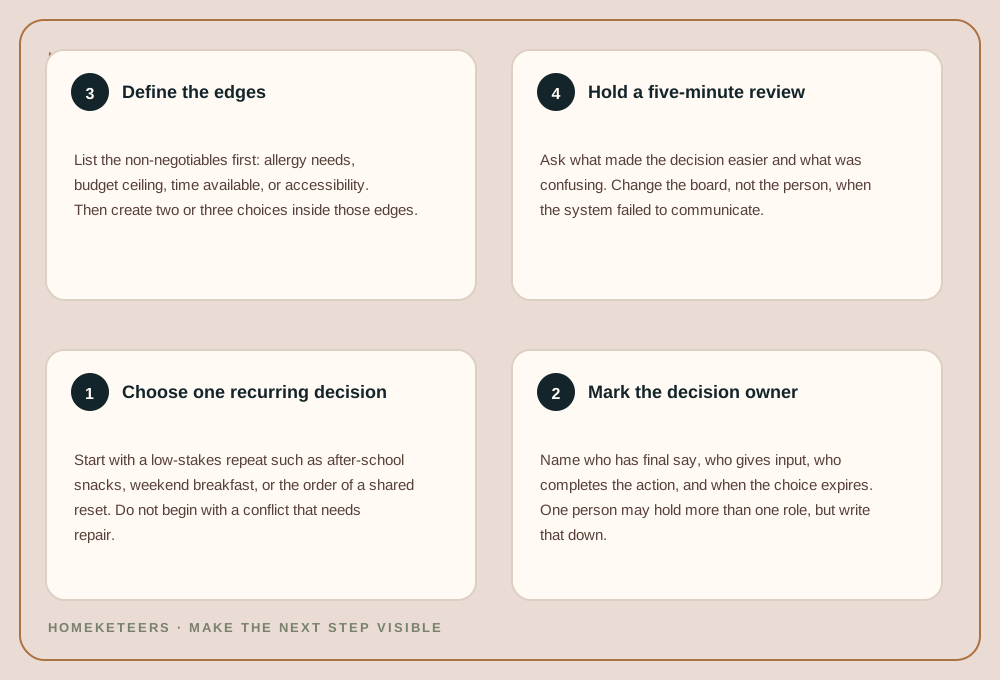
- Choose one recurring decision. Start with a low-stakes repeat such as after-school snacks, weekend breakfast, or the order of a shared reset. Do not begin with a conflict that needs repair.
- Mark the decision owner. Name who has final say, who gives input, who completes the action, and when the choice expires. One person may hold more than one role, but write that down.
- Define the edges. List the non-negotiables first: allergy needs, budget ceiling, time available, or accessibility. Then create two or three choices inside those edges.
- Hold a five-minute review. Ask what made the decision easier and what was confusing. Change the board, not the person, when the system failed to communicate.
- Close the loop. Record the result and the next review date. A decision stays open only when there is a named reason and a person responsible for revisiting it.
The process at a glance
Four specific checkpoints make this guide easier to use at the table, workbench, garden, or kitchen.
Read the illustrated example
- Choose one recurring decision
- Start with a low-stakes repeat such as after-school snacks, weekend breakfast, or the order of a shared reset. Do not begin with a conflict that needs repair.
- Mark the decision owner
- Name who has final say, who gives input, who completes the action, and when the choice expires. One person may hold more than one role, but write that down.
- Define the edges
- List the non-negotiables first: allergy needs, budget ceiling, time available, or accessibility. Then create two or three choices inside those edges.
- Hold a five-minute review
- Ask what made the decision easier and what was confusing. Change the board, not the person, when the system failed to communicate.
Check before moving on: Start with one step, then check the condition named in the article before continuing.
Choose the version that fits today
- Young children: Use pictures and two concrete options. Keep adult financial or safety responsibility with adults.
- Teens: Offer real authority over a defined area, such as their own school-morning sequence, and agree on what happens if the plan needs adjustment.
- Different schedules: Use a paper board at the point of action or a shared note everyone can reach without relying on one person’s phone.
Common snags, and a better adjustment
- Calling input ownership: A person who gives an opinion is not automatically responsible for carrying out the result.
- Voting on everything: Use group choice for shared preferences, clear ownership for tasks, and adult authority for adult obligations.
- Keeping the board vague: “Help more” is not a decision. Name the action, owner, and finish condition.
A worked example
For Saturday breakfast, the adult sets a $20 budget and handles the grocery trip. Each child chooses one topping, and one child sets the table while another clears it. The board records the plan before Friday, so Saturday does not begin with a new negotiation.
A board people can use
Use four columns: decision, owner, input needed, and decide-by time. Keep no more than three decisions open at once. If every household question goes on the board, it becomes another place the primary planner must maintain.
For weekday lunches, an adult can set the budget and allergy rules while each child chooses an option by Sunday evening. Name who buys the food and what happens if nobody chooses by the deadline. A clear default prevents silence from becoming one person’s last-minute job.
When a board is the wrong tool
Do not use a household vote to settle safety, privacy, money another person controls, or a commitment that affects someone who cannot freely opt out. The responsible adult should state the limit and identify which choices remain open.
Review after two weeks. Remove decisions that no longer repeat and clarify any item that needed reminders. The useful test is whether ownership became clearer, not whether every line was completed perfectly.
Keep the board from becoming another chore
Put the board where the decision happens, not in a dashboard only one person checks. Agree on when it is updated and who closes a decision. If the board requires daily polishing, shorten it to the next decision and the next owner.
When a decision is missed, first check whether the deadline, choice, or owner was unclear. Adjust the system before assuming someone did not care. Retire the board if a brief conversation or standing default solves the recurring issue with less effort.