
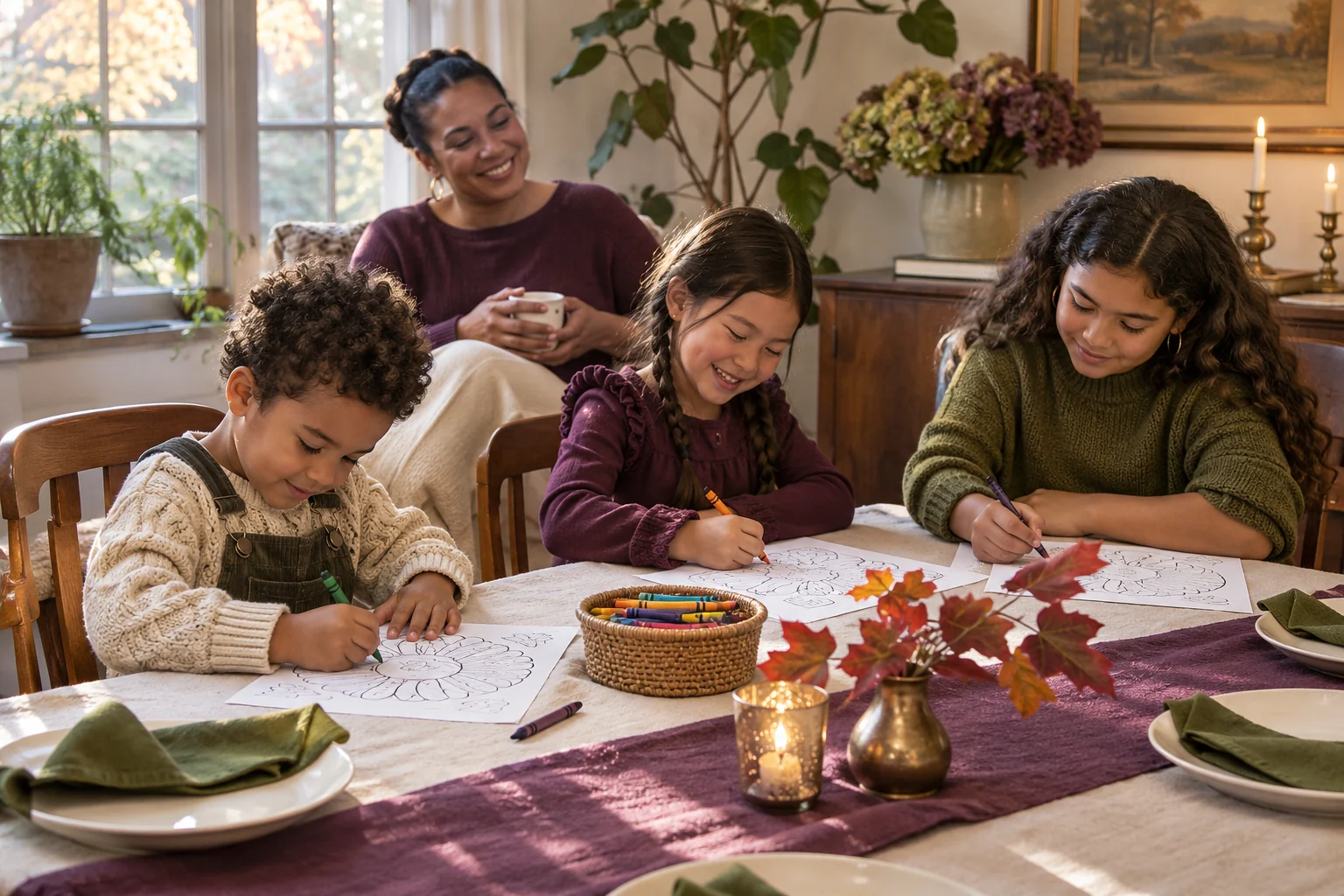
A Thanksgiving kids’ table can make the meal easier for everyone, but only when the setup fits the children who will actually sit there. A two-year-old, a new reader, and a ten-year-old do not need the same activity, the same amount of help, or the same expectation for how long they will stay seated. The simplest solution is a shared table with choices that scale by age, a few clear boundaries, and activities that are ready before the food is served.
This guide gives you a practical plan for setting up a Thanksgiving table for children ages 2 through 12 and older. You will find an age-by-age activity menu, a print-and-place setup, a low-stress timeline, a mixed-age game, and ways to make the table more comfortable for children who need movement, quiet, or extra support. The goal is connection and a calmer meal, not perfect behavior or a picture-perfect table.
Start with the table’s real job
A kids’ table is not a holding area and children are not responsible for entertaining the adults. Think of it as a comfortable place where each child can eat, participate at their own level, and take a break when they need one. Some children will finish a page and start talking. Some will want an adult nearby. Some will leave the table before dessert. Build a plan that can handle all three.
Before you set anything out, answer three questions: How many children will sit together? What is the youngest child’s safe, comfortable reach? And when during the meal do you most need a quiet activity, before dinner, while adults finish serving, or after the children have eaten? Those answers determine the layout better than buying more supplies.
Choose activities that fit the child, not just the age label
Age ranges are starting points, not rules. A child may enjoy a simpler page, need a more challenging puzzle, or prefer to skip paper entirely. Put two or three choices within reach and let each child choose. Avoid assigning a page based on what you think a child should be able to do. Choice protects confidence and keeps the activity from turning into a test.
For toddlers and preschoolers, ages 2-4
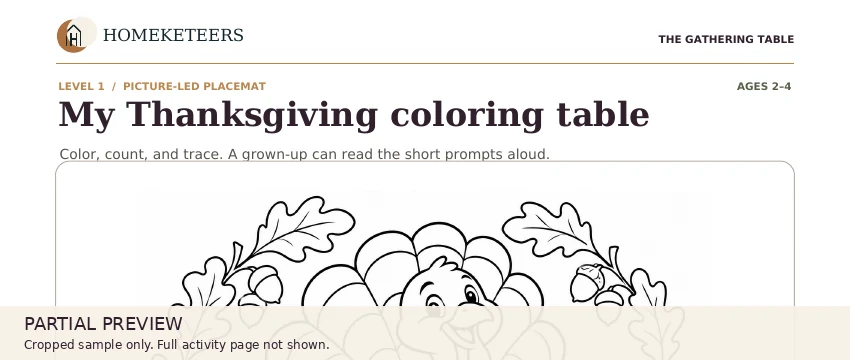
Young children need bold pictures, large open spaces, and actions they can do without reading. A coloring placemat, a simple picture hunt, or a prompt such as “find something round” gives them a clear place to begin. Offer a few chunky crayons and keep small pieces, scissors, glue, and loose game tokens off the table.
Use short invitations rather than a stack of instructions: “Would you like to color the big leaf?” or “Can you find something that looks like dinner?” Toddlers may color for three minutes, eat, and return to the page later. That is successful use. If a child is still mouthing objects, supervise the crayons closely and choose materials suitable for that child.
For early readers, ages 5-7
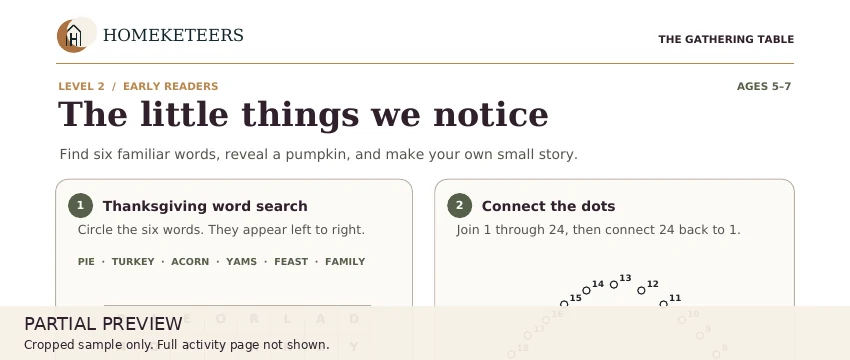
Early readers can follow one- or two-step directions, find familiar words, solve a small maze, or complete a short matching activity. Keep directions visible and concrete. Instead of a long paragraph, use a clear action such as “Circle the three things you might see at a fall table.” Large print and generous answer spaces make the page easier to use beside a plate.
Pair reading with a choice of how to respond. A child can circle, draw, point, or tell an adult the answer. If the page includes a word search or puzzle, have a nearby adult available without hovering. The activity should create a small win, not interrupt the meal with a stream of help requests.
For older children, ages 8-12 and up
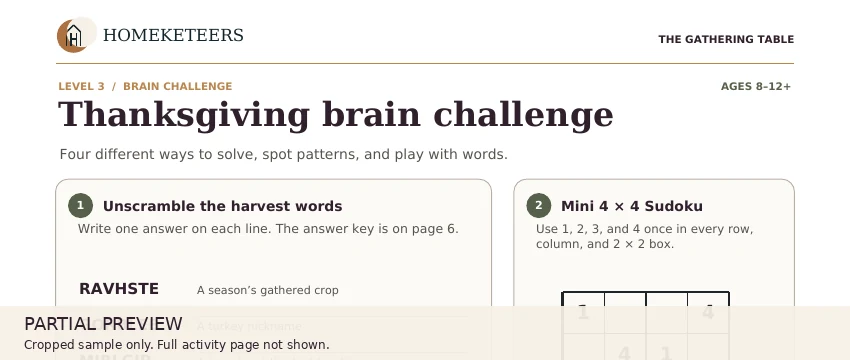
Older kids often appreciate a genuine challenge, not a page that feels like a younger child’s worksheet with smaller pictures. Try a logic puzzle, a word challenge, a short creative prompt, or a family question that invites a real answer. Give them enough room to write and make it clear that they may pass on sharing anything personal.
If a child finishes early, offer a second option that does not require an adult to print or explain something mid-meal. A puzzle with an answer key lets the child check their work independently. A prompt such as “invent a new side dish using three ingredients on the table” can invite imagination without turning dinner into a competition.
Set up one table that works across ages
- Choose seats before guests arrive. Put the youngest children beside an adult who can help with food, utensils, and transitions. Seat siblings or cousins together when that helps them feel at ease, and leave an easy path for a child who may need to step away.
- Place a page at each seat, then set out a small shared cup of crayons. Keep the center clear for serving dishes. Avoid placing a full craft station in the middle of the meal, where supplies compete with food and conversation.
- Make the activity optional. Tell children, “Choose a page if you want one. You can draw, talk, eat, or take a break.” That sentence gives them permission to use the table without promising they will sit still for the entire gathering.
- Keep food and play separate. Put papers under plates or use placemats, but move coloring tools aside when hot dishes arrive. Skip activities that require cutting, taping, glue, batteries, or adult setup during dinner.
- Plan a quiet exit. Identify a nearby chair, living-room corner, or supervised space where a child can reset. A short break is often easier than asking a tired child to push through.
A simple Thanksgiving host timeline
- The day before: Count the children, confirm ages and any access or sensory needs with their caregiver, and print only the pages you expect to use. Print one extra page for a spill or a guest who joins at the last minute.
- One hour before guests arrive: Set up seats, check that crayons work, and place the pages. Keep the table free of food until serving time. Put any answer key with the host materials rather than on the children’s table.
- As children arrive: Point out the choices once. Let children start when they are ready. Do not make the activity an entrance requirement or ask children to finish a page before eating.
- When dinner is served: Move supplies to one side or into the shared cup. Let children participate in the meal. If an activity is in the way, pause it and bring it back after plates are cleared.
- After the meal: Offer one optional shared game or a chance to finish a page. Collect reusable pages, recycle the rest, and note what worked for next year. You do not need to preserve every sheet for the gathering to have been worthwhile.
A mixed-age game that needs no extra supplies
Try “Thanksgiving Table Detective.” One person chooses something visible in the room or on the table and gives a clue: “I’m thinking of something that is orange,” or “I’m thinking of something we use to serve food.” Everyone can guess, point, or pass. For older children, add a second clue or ask them to make one. For toddlers, let an adult offer two choices. Keep the rounds short and let any child stop playing without explanation.
A second option is “One good thing, one silly thing.” Invite each person to name one thing they enjoyed today and one imaginary thing they would add to Thanksgiving, such as a moon-shaped pie or a pet turkey who tells jokes. Sharing is optional. Children can draw instead, whisper to a caregiver, or simply listen. The point is a low-pressure moment together, not a forced gratitude exercise.
Make the setup more comfortable and inclusive
A festive gathering can be loud, crowded, and full of unfamiliar smells and people. Ask caregivers privately what would help their child feel comfortable. Keep a seat available near a trusted adult, tell children what will happen next, and avoid making them hug, perform, answer personal questions, or pose for a photograph. A child who watches quietly is still included.
Consider reach and mobility before decorating. Make sure a child can sit securely, reach their food, and get in and out safely. Keep candles, hot serving dishes, sharp utensils, choking hazards, and breakable decor away from small hands. If a child has an allergy or food restriction, confirm the meal plan with their caregiver and prevent shared crayons or surfaces from moving between food and art.
For children who need movement, plan a small helper job with a clear beginning and end, such as carrying napkins with an adult or choosing the next song. Do not make a child responsible for serving others. For a child who prefers quiet, offer a low-stimulation seat and let them use the page without having to join a group game.
What to print for a ready-to-use kids’ table
If you want a no-prep printable option, The Thanksgiving Kids’ Table Pack is designed around these different ages. It includes a host guide, a preschool placemat, an early-reader activity, an older-child brain challenge, a mixed-age gratitude game, and a master answer key. The same six pages are supplied in U.S. Letter and 11 × 17 formats, with black-and-white layouts intended for ordinary home printing.
The practical value is the age range in one coordinated set: a host can print the page that fits each child, put the mixed-age game within reach, and keep the answer key nearby. No cutting or craft assembly is required. You will still need basic crayons or pencils, and the pages are optional tools rather than a promise that every child will stay seated through dinner.
Preview the pages without giving away the activities
These cropped samples show the pack’s real page design and age levels. They are partial previews only. The complete activity pages, family game, and answer key are included in the paid download.
Print and place without wasting paper
- Use the host guide first. It tells you what is included and which pages are intended for each age level.
- Print one child page per child, then add one extra only if you expect a spill or an unexpected guest. The Letter size is the straightforward choice for a home printer. Choose 11 × 17 when you want a larger placemat and have access to a printer that supports tabloid paper.
- Print at actual size or fit to page, depending on your printer. Check the preview before printing a stack so that page edges, instructions, and answer spaces are not clipped.
- Use pencils or crayons and keep the answer key with the host. If you print the older-child challenge, the key lets a child check the puzzle without waiting for an adult to finish hosting.
- If you are printing for multiple households, check the product’s usage terms before sharing or distributing copies. For one family gathering, print the pages you need and keep the digital file for your own future use according to the listed license.
A realistic expectation for the day
A useful kids’ table does not eliminate noise, movement, sibling conflict, or the need for adult attention. It removes avoidable friction: no one is scrambling for supplies, a child is not handed a puzzle they cannot read, and the host has a simple activity ready when the table needs a reset. Give children choices, let the meal stay human, and let the pages do one modest job well.
Frequently asked questions
What are good Thanksgiving activities for kids at the table?
Choose activities that match reading and motor skills: picture-led coloring for preschoolers, short matching or maze activities for early readers, and a real puzzle or creative prompt for older children. A short spoken guessing game can include several ages without supplies.
How do I keep toddlers occupied at Thanksgiving dinner?
Place a simple picture page and a few chunky crayons within reach, seat the toddler beside a caregiver, and expect brief bursts of attention. Keep small pieces, hot dishes, sharp tools, and choking hazards away from the child. Do not rely on a worksheet as supervision.
What should I print for a mixed-age Thanksgiving kids’ table?
Print different pages for different reading levels, plus one shared game for children who want to participate together. The Thanksgiving Kids’ Table Pack provides six coordinated pages for ages 2-12+ in Letter and 11 × 17 formats.
How many activities should I prepare?
One page per child and one optional shared game are usually enough. A large bundle can create more sorting and printing work than the gathering needs. Keep a backup activity on hand only if your meal is long or children will have a separate waiting period.
Do children need to sit at a separate kids’ table?
No. Use a separate table only if it helps with space, access, or comfort. Children can sit with adults and use the same age-appropriate pages. The best arrangement is the one where children can eat safely and connect with people they trust.
A little preparation can make the children’s part of Thanksgiving feel considered instead of improvised. Print what fits, keep the center of the table clear, offer an easy way to take a break, and let each child decide how much they want to join in. That is enough structure to help the gathering flow without asking children to perform.