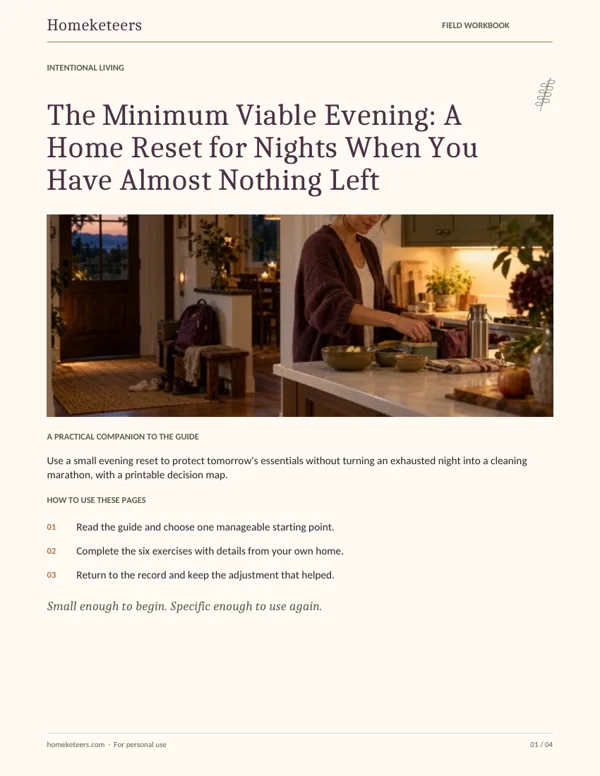
Some evenings offer enough energy for cooking, conversation, laundry, and a little beauty. Other evenings offer enough energy to sit down and stay there. A useful home routine needs to accommodate both. The minimum viable evening is a deliberate lower setting: a few actions that protect safety, tomorrow's first obligations, and your chance to stop working.
It is not a shorter version of a perfect-house checklist. It asks a different question: what becomes genuinely harder if this waits until morning? Dishes may be able to wait. Food that needs refrigeration cannot. A crowded counter may be annoying. An inaccessible required school item can derail departure. Sort those differences before spending the small amount of energy you have left.
Make a three-level list in daylight
Design the routine when you are not already exhausted. Create three levels: protect, prepare, and optional. Protect includes immediate household safety, suitable food storage, essential care routines, and anything required for a safe night. Prepare includes the first thing tomorrow's schedule needs. Optional includes tidying and improvement that can wait without a serious consequence.
Use the household's actual needs. For one family, the morning dependency is a charged mobility device. For another, it is a signed form or work uniform. Do not borrow someone else's aesthetic priorities. If health or care instructions govern a task, follow those instructions rather than changing them to fit this routine. The reset supports necessary care; it does not replace it.
Start with a stopping time
Choose a ten-minute work window or a smaller limit you can manage. Name the end before the beginning. Otherwise, putting one dish away can become reorganizing the cupboard and leave you more depleted. Use a timer if it helps, but stop sooner if you are physically unwell or the work is beyond what you can safely do.
Walk one short route through the house. Check perishables, walking paths, exits, and the first morning dependency. Avoid room-by-room inspection. A whole-house scan creates a list too large for the purpose. If something urgent appears, address that and let the optional portion disappear. The routine is meant to support judgment, not override it.
Prepare one first action for tomorrow
Set out the object that makes the morning begin. This might be a backpack by the door, oatmeal ingredients beside a bowl, or the document needed for a meeting. Put it where the action will happen, not wherever it looks tidy. If the household already has a working station, use it rather than creating a second one for this routine.
Do not require yourself to prepare the whole day. A complete lunch plan, perfect breakfast, matching outfits, and spotless sink may be desirable, but they are not one first action. Choose the dependency with the largest consequence if missing. Keep a fallback for the rest, such as an ordinary pantry breakfast or a simplified lunch assembled in the morning.
Share the reset in concrete pieces
Say what needs doing, by whom, and what 'done' means. 'Help with the house' is too broad. 'Put your backpack and shoes at the door, then tell me if a form needs signing' is clear. Give children tasks suited to their abilities. Another adult can own a complete task without requiring you to supervise each movement.
If you live alone or the other people cannot help, reduce the list instead of pretending support exists. Place a laundry basket nearby for loose items that block a needed surface. This is temporary containment, not a new sorting project. Add a later review so the basket does not become permanent invisible work.
An illustrative low-energy evening
A mother returns late after a long appointment. She refrigerates the supper leftovers, clears a safe path between bedrooms and the bathroom, plugs in the device needed for morning, and checks the first departure time. Her teenager sets out their own school things. They leave the remaining dishes and folded laundry alone. Eight minutes later, the working part of the evening is over.
The next morning still contains ordinary tasks. The difference is that the most consequential dependencies are ready. A minimum routine cannot make life effortless, and it should not be sold as a cure for overload. It is a practical choice about where the remaining effort will do the most good.
Make the end visible
Close the list after protect and prepare are handled. Write tomorrow's optional task on a separate page if it helps you release it for the night. Turn off the work light, put the timer away, or move the list back to its drawer. These simple signals mark the end of household work without requiring a ceremonial performance.
If every night needs the minimum setting, review the demands in daylight. The problem may be an unrealistic schedule, a missing handoff, or too much work assigned to one person. Keep the evening routine small while investigating the larger issue. You deserve a home plan that can survive an ordinary hard day, rather than one that works only when you are already rested.
Your Homeketeers field workbook: put this guide into practice
Use the Evening Floor workbook before a hard night arrives. It separates consequences from preferences and gives the household a shared stopping rule. Fill the first page in daylight, then use the one-page night card without rereading the whole plan. Keep essential care instructions in their normal place; this card should point to them, not replace them.
Protect: tasks that cannot safely wait
Write the household's true essentials. Include appropriate storage of perishable food, a safe route to necessary rooms, and any prescribed care routine that applies. Record who can complete each action. Do not add decorative or organizational goals here. If a task needs special knowledge, note where its established instructions are kept. The protect list should remain short enough to recognize at a glance.
Prepare: tomorrow's first dependency
Write the first fixed obligation, its time, and the object needed to begin it. Example: leave at 7:30, with the school backpack, signed form, and working keys accessible. Name only the dependency that creates the biggest problem when absent. If tomorrow has no fixed departure, preparation may simply mean a usable breakfast space and the supplies for your first ordinary care task.
Optional: work that may remain unfinished
List the tasks that can wait and decide where they will be recorded. Washing every nonessential dish, putting away every clean item, and reorganizing a shelf usually belong here. A task may move to protect if its condition creates an actual safety problem. Do not decide by how visible the mess is. Visibility and consequence are different, and the worksheet is designed to preserve that distinction.
The eight-minute route
Draw or describe one short route from kitchen to doorway to the required care station. Place the highest-consequence actions first. Estimate the minutes honestly and leave room for an interruption. If the route cannot fit the available energy, remove a preparation item or ask an available household member to own it. A workable route is better than a complete list you cannot begin.
The household handoff
Write a complete task with a clear finish: each person places their own morning belongings in the agreed location and reports a missing item before the stopping time. Add a fallback for a young child or someone who needs help. Record who checks the shared item, such as the departure time. Avoid assigning yourself the task of reminding everyone about every step; that recreates the invisible workload.
The stop signal and next-day review
Choose an unmistakable ending: timer off, list closed, kitchen work light off. Write one sentence you can use with the household: 'The essentials are covered; the remaining work waits.' Add a daylight review time for tasks that were deferred. A stopping rule works only when the unfinished tasks have a reasonable later destination, rather than becoming a silent accusation when you wake up.
Keep a record that tells you what actually changed
After three uses, compare how the evening felt to the morning's actual needs. Which item prevented a real difficulty? Which optional item could safely stay optional? Was the reset truly under your chosen time, or did it keep expanding? Remove a step that has no clear consequence and improve a step that still depends on searching. Record a fallback version for illness or unexpected travel. Keep both versions short. The useful outcome is not a photographable room. It is a safer, less complicated transition into tomorrow, followed by a clear end to tonight's work.