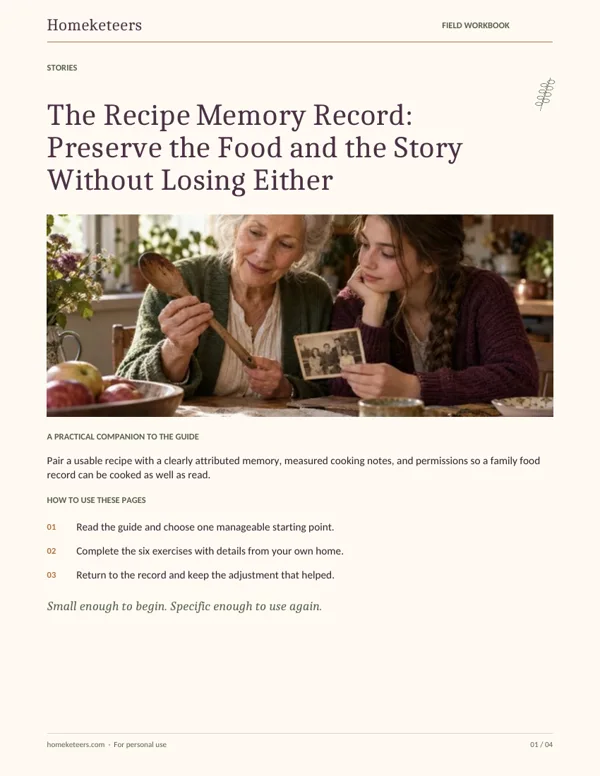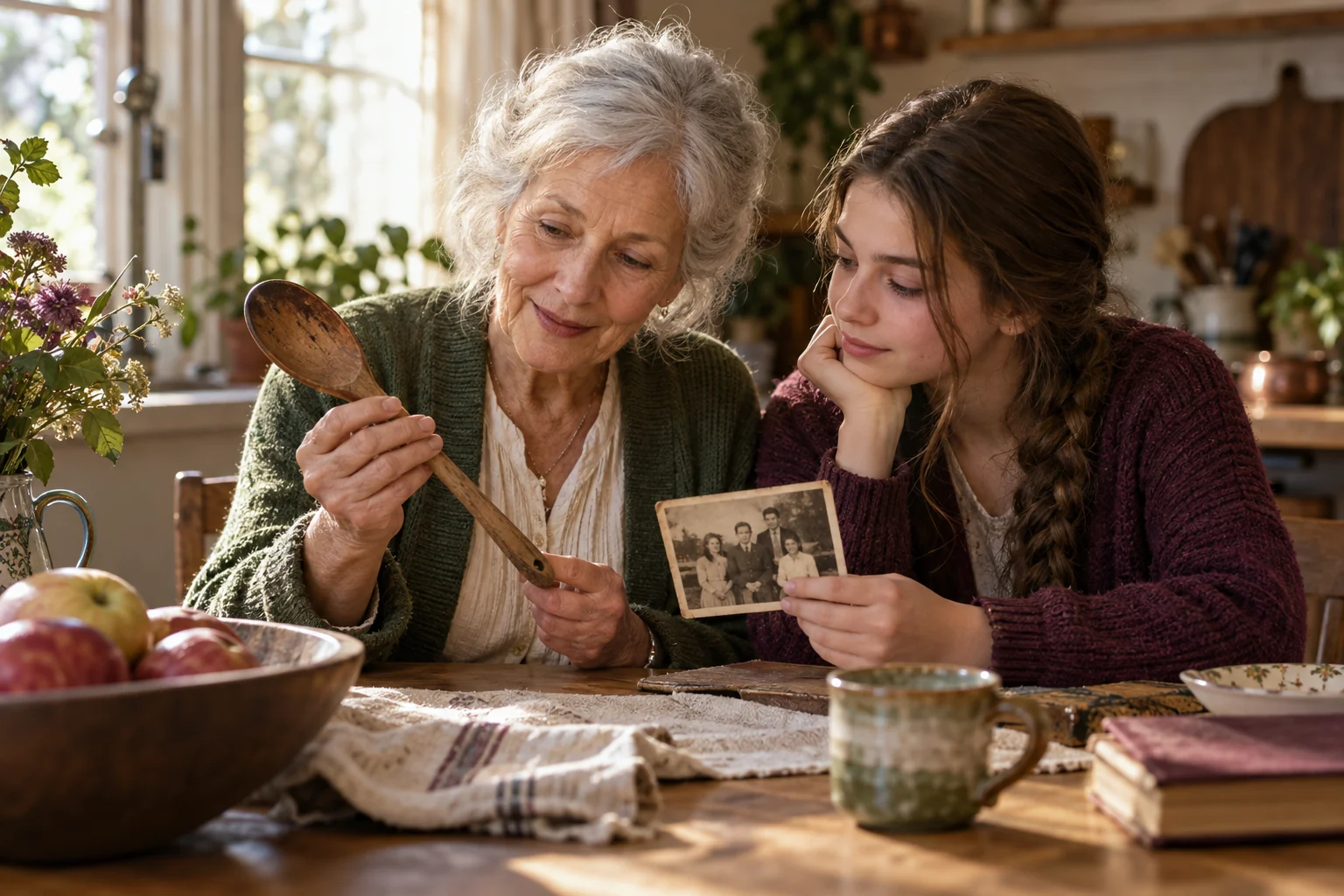
A handwritten recipe can contain two different inheritances: a method for making food and a story about the person who made it. Those inheritances need different kinds of care. A direction such as “a good handful” may be meaningful to someone who watched the cook, but difficult for a reader who never did. A polished rewrite can solve the measurement problem while quietly erasing the voice that made the card precious.
The Homeketeers recipe memory record preserves both layers. Keep the original wording or a faithful image, create a separate usable cooking version, and attach a short story with clear attribution. You do not have to pretend that a family recipe was always exact. You can document how you learned to make it without replacing the original with a claim of certainty.
Choose one recipe with a practical boundary
Begin with something you can reasonably cook and document now. A familiar loaf, soup, or ordinary weeknight dish is often easier than an elaborate holiday recipe requiring specialist equipment. Decide whether your first record will preserve a person’s method, your own adapted version, or both. Give the version a name that reflects the choice.
If the recipe involves canning, fermentation, raw animal products, or another process with specific safety requirements, use current authoritative guidance for the method. A family tradition is not sufficient evidence that a preservation process is safe. You can preserve the story of an old method without instructing readers to repeat an unsafe practice. Keep the historical account and the current cooking direction clearly separate.
Capture the original before improving anything
Photograph or scan the card, notebook page, or relevant object with permission. Use copies for everyday kitchen handling and keep irreplaceable originals away from heat, water, and grease. Record where the recipe came from, who wrote it if known, and when you received it. Do not assume the handwriting identifies the recipe’s original creator.
Transcribe the wording faithfully, including uncertain words marked as uncertain. If a stained line might say teaspoon or tablespoon, do not silently choose the amount that seems likely. Mark the question and investigate before cooking. An accurate transcription can contain a gap. Filling it with a guess and presenting it as inherited fact creates a less trustworthy record.
Ask for the story without requiring sentiment
Invite the person connected to the recipe to describe when it was made, who usually cooked it, and one detail they remember. Ask what they want included and who may read it. A recipe story may be joyful, complicated, ordinary, or brief. Do not require it to become a story of perfect family closeness in order to deserve preservation.
Keep exact quotations only when you recorded the words accurately and have permission to use them. Otherwise write a clearly attributed summary. If the recipe comes from a published book, website, or another cook, record that source. Family use does not automatically make a recipe family-authored. Attribution can be part of the story rather than an interruption to it.
Build a separate cooking version
List ingredients in the order they are used. Add quantities, preparation notes, equipment, and a realistic yield. Translate imprecise directions through observation during a cook, not by inventing a conversion. Weigh or measure the “handful” you actually use and label that amount as your working version. Keep the original phrase beside it if it carries meaning.
Write the sequence in discrete steps. Include the heat level or oven setting, approximate time, and the observable endpoint. “Cook until the onions are soft and translucent” carries more usable information than time alone. Note what happened with your equipment. A modern oven, a different pan, or a changed ingredient may produce a valid adaptation, but it should not be mislabeled as exactly the old method.
Document one cook before deciding the final wording
Set up the notebook before starting. Record ingredient brands or types when they could affect the result. Note pan dimensions, oven setting, added liquid, and any deviation from the working version. Take a photograph of the finished food if you want a visual record, but do not use appearance as the only evidence that it cooked properly.
Write your observations immediately afterward: texture, serving size, flavor, and any unclear step. If the recipe needs revision, change one significant variable where practical and cook again. Do not describe a version as tested simply because it has been formatted professionally. The record should distinguish an unverified transcription from a version someone has actually cooked and observed.
Keep the story beside the recipe rather than inside every step
Use a two-page structure. The first page holds the cooking version and practical notes. The second holds the memory, source, original wording, and version history. This lets a person cook without searching through a long narrative for the oven temperature. It also lets another reader enjoy the story without treating every remembered detail as a technical direction.
Include a short version label, such as “working kitchen version, October 2026.” Add who prepared the adaptation and what changed. A recipe can evolve honestly. The label prevents the newest page from pretending to be an unchanged artifact passed down intact through several generations.
A worked example with an imprecise apple cake
Elena has a card that says “two good apples” and “bake in the square tin.” She photographs the card and asks her mother about the pan. They identify a nine-inch square tin, but her mother is unsure whether the original apples were peeled. Elena keeps that uncertainty in the record. During her own cook, she weighs the prepared apples and records the amount.
Her cooking page says that the measured quantity is Elena’s working adaptation. The memory page describes when the cake appeared at family meals and attributes the story to her mother. Neither page claims to solve every uncertainty. Together they preserve something that can be made again and something that can be remembered accurately.
Add the information the next cook will need
Record known allergens, substitutions you actually tried, storage instructions appropriate to the food, and any safety-relevant endpoint. Check current guidance rather than assuming the recipe’s age makes it dependable. Keep “not tried” beside speculative substitutions. A useful family record can include suggestions without disguising them as demonstrated results.
Save a digital copy with a clear filename and a readable format. Keep a printed working copy in the kitchen if that suits the household. Before sharing publicly, check the permission and source record again. A family collection can remain private, and a private recipe deserves the same clarity as a published one. Preservation is complete when the next person can understand what the page knows and what it does not.
Your Homeketeers field workbook: put this guide into practice
The companion story workbook gives you a place to separate remembered detail, another person’s words, and your own interpretation. Use the six working pages in order or choose the page that helps you finish one small record. A completed story can remain private.
Identify the original source
Record the card, notebook, person, or published source. Note who wrote the words and who may have created the recipe, keeping uncertainty visible. Add the date you received or copied it. Preserve an image with permission before making edits, and use a kitchen copy rather than the fragile original.
Separate wording from interpretation
Transcribe the original phrases in one space and questions in another. Mark illegible quantities or missing equipment details. Do not convert a guess into a fact. Write who might clarify each question and whether cooking should wait until the safety-relevant uncertainty is resolved.
Capture the attributed memory
Write who shared the story, when, and with what audience permission. Separate exact quotation from summary. Ask for one concrete detail rather than a complete family history. Leave room for an ordinary or complicated memory without forcing the food into a sentimental account.
Make the working cooking version
List ordered ingredients, measured quantities, equipment, yield, and observable endpoints. Label adapted measurements as your version. Keep original phrases nearby where useful. A working version should make the dish usable while showing the difference between inherited wording and present-day decisions.
Document an actual cook
Record date, ingredient types, pan size, timing, changes, and result. Mark the version unverified until you have cooked it. Note one revision for the next attempt. Keep speculative substitutions separate from those actually tried, so a future reader can assess the reliability of each note.
Create the final two-page record
Place the cooking method on one page and memory, attribution, permissions, and version history on the other. Add storage and allergy notes appropriate to the dish. Save a clear digital copy and define the allowed audience. The two layers should remain connected without making either harder to use.
Keep a record that tells you what actually changed
When the record is finished, give it to someone who did not watch the original cook and ask whether the instructions are usable. Then read the memory page separately and check whether attribution and uncertainty remain clear. Keep both kinds of feedback. A recipe becomes a durable family record when it can support another cook and honor another person’s voice without pretending those are the same task.