The best family stories often arrive while someone is peeling an apple or looking for a photograph. Trying to preserve them can change the atmosphere. A phone appears, questions become formal, and a person who was comfortably remembering suddenly feels responsible for producing a complete history. The Homeketeers twenty-minute family story gives the conversation a smaller container and a clear permission structure.
Choose one subject, ask how the person wants it recorded, and leave room for them to change their mind. You are making a record of a voice, not extracting everything someone knows. The finished piece might be a short audio file, a page of notes, or a paragraph the storyteller has approved. Its value does not depend on publication or on an emotionally dramatic revelation.
Choose a subject that fits a real conversation
Begin with one place, object, skill, or ordinary routine. Ask about the kitchen in a particular home, the first job someone remembers, a garden they tended, or how a familiar recipe entered the family. Avoid opening with “tell me your whole life.” A narrower question gives the person a place to stand and makes it easier to preserve a coherent story.
Send the subject ahead if that would help. Some people prefer time to remember names or find a photograph. Others speak more freely when the question is informal. Ask what suits them rather than assuming spontaneity is always more authentic. A story prepared in advance is still their story. The goal is comfort and clarity, not catching someone unguarded.
Agree on the record before pressing anything
Ask whether the person prefers notes, audio, or no recording. Explain who will see or hear the result, where you plan to keep it, and whether you hope to share any part. Permission to talk is not automatically permission to publish. If recording, follow applicable consent requirements and obtain explicit agreement from everyone involved. When in doubt about a legal requirement, use written notes with the person’s permission and seek appropriate guidance before recording.
Agree that they can pause, skip a question, or ask you to remove a section. Do not promise secrecy you cannot provide if a cloud service automatically uploads recordings or if other people have access to the device. Check the actual settings before the conversation. A simple local note may be more suitable than an elaborate platform neither of you understands.
Prepare the room for listening
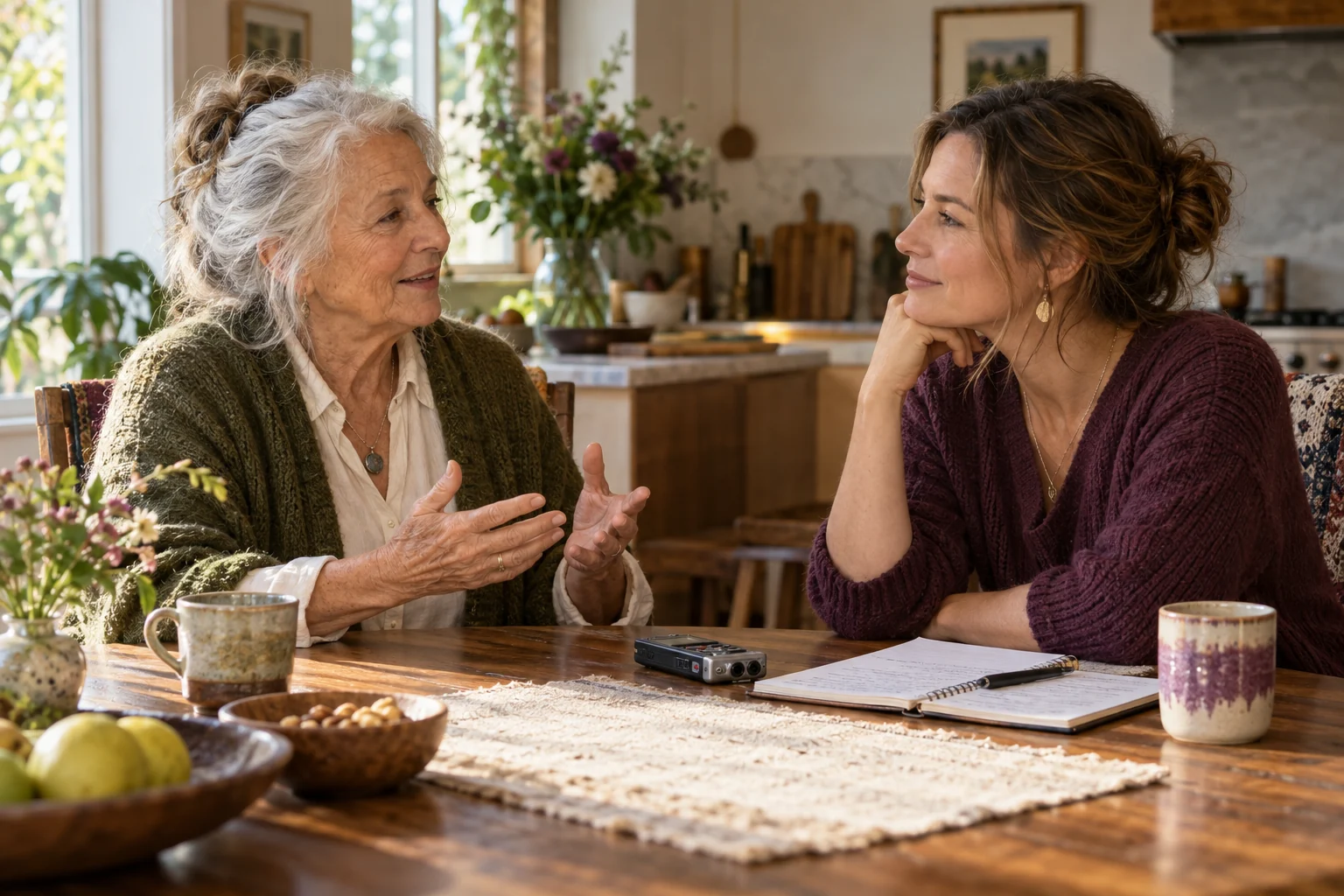
Choose a place where the person can hear comfortably and sit without strain. Reduce competing sound if they want an audio record. Put the device somewhere visible rather than hiding it. Test a short sample together so you know the voice is audible. If the technology creates frustration, return to notes. Preserving the relationship matters more than producing the ideal file format.
Keep water nearby and choose a time that suits their energy. Twenty minutes is an upper boundary for this exercise, not a demand that the person keep speaking until the timer ends. Some stories take five minutes. Some need a later return. Let the person’s comfort determine the pace and stop when the agreed time or their attention is finished.
Use three prompts and follow the living detail
Begin with “What do you remember first about that place or moment?” Then ask “What happened next?” Finally ask “What would you want someone who was not there to understand?” These prompts create a simple movement from setting to event to meaning. You do not need to ask them in a rigid order if the story already flows.
Follow one specific detail with a gentle question: what the room looked like, who was present, or how a tool was used. Avoid stacking several questions together. Leave pauses. A silence may mean the person is thinking, not that the conversation has failed. Do not supply an answer because you believe you know what they must have felt.
Separate listening from fact-checking
If a date or name seems inconsistent, make a private note to revisit it later. Interrupting every discrepancy can turn remembering into a test. You can ask, at a natural pause, whether the date is certain or approximate. The record can say “around 1978” or “as I remember it.” Those phrases preserve useful uncertainty rather than pretending memory functions like a database.
Keep the storyteller’s experience distinct from independently established facts. If two relatives remember differently, label each account rather than combining them into a false consensus. A family story can hold several perspectives. You are not required to resolve every disagreement in order to preserve a voice accurately.
Close with a choice, not another demand
Before ending, ask whether there is anything they want left out or clarified. Thank them for what they chose to share. Tell them when you will bring the notes or short draft back for review. Avoid immediately asking for the next story unless they invite it. A respectful ending makes another conversation possible without making the person feel their memory has become a project you now own.
Afterward, write a short context note: date, place, subject, people present, and agreed sharing limits. If you made audio, create a clear filename and a backup consistent with the permission you received. Do not upload the file to an automated transcription service without checking how it handles private information and whether the storyteller agreed to that use.
Make a readable record without rewriting the person
Prepare a short summary or transcript excerpt. Preserve distinctive wording when you can do so accurately. If you paraphrase, label it as a summary. Remove repetition for readability only when doing so does not change meaning, and let the storyteller review the result. Do not manufacture polished dialogue from imperfect notes and present it as an exact quotation.
For a private family page, a simple structure works: the subject, the person’s account, a context note, and any unresolved detail. Keep your own interpretation in a separate paragraph. The distinction protects both voices. A reader can appreciate what the storyteller said without mistaking your later reflection for their original words.
A worked example around a kitchen table
Nina asks her aunt about the small grocery where she worked as a teenager. Her aunt prefers notes and says the story may be shared with family but not posted publicly. Nina asks about the first day, the daily routine, and one thing she wishes younger relatives understood. A detail about wrapping purchases in paper becomes the center of the story.
Nina drafts one page and marks the year as approximate. Her aunt corrects a coworker’s name and removes a detail about another person. The finished page is modest but trustworthy. It carries a voice and a clear history of permission, which makes it more valuable than a longer account assembled from guesses and unreviewed recordings.
Your Homeketeers field workbook: put this guide into practice
The companion story workbook gives you a place to separate remembered detail, another person’s words, and your own interpretation. Use the six working pages in order or choose the page that helps you finish one small record. A completed story can remain private.
Choose the bounded subject
Write one place, object, skill, or routine you want to ask about. Add why it matters and what is outside the scope. Prepare no more than three opening prompts. A bounded subject gives the storyteller a manageable invitation and gives you a realistic chance of finishing a coherent record.
Record the sharing agreement
Note whether the person wants notes, audio, or no record. Write the intended audience, storage location, review process, and any restrictions. Keep publication permission separate from conversation permission. If the plan changes later, return to the person rather than treating the original agreement as unlimited.
Prepare the listening conditions
Record time, location, hearing needs, device choice, and the result of any audio test. Check automatic upload settings and who can access the device. Add a simple alternative if the technology fails. The room and method should support the person, not make them manage your equipment.
Keep a detail and uncertainty map
Use separate spaces for exact words, paraphrase, names to confirm, and approximate dates. Mark a pause or skipped subject without filling it in. This map protects the difference between what you heard and what you later inferred. It also makes the review conversation easier and more specific.
Draft one reviewable page
Write a short beginning, event sequence, and closing meaning. Keep your own reflection separate. Label paraphrase and uncertainty. Bring the page back to the storyteller and record corrections or removals. A reviewable page gives permission a practical form instead of leaving it as a vague intention.
Save a usable final record
Record filename, date, subject, approved audience, backup location, and any access limits. Keep the agreement with the story. Write what must happen before future sharing. A saved voice is useful only if someone can find it and understand how the storyteller wanted it treated.
Keep a record that tells you what actually changed
After the review, ask whether the final piece feels like something the person chose to share. Keep the corrected version and make its sharing limits visible. Let the next conversation happen when there is another bounded subject and genuine willingness. Family storytelling can become a practice of attention, but it should never require a person to surrender control of their memories to prove they have something worth preserving.