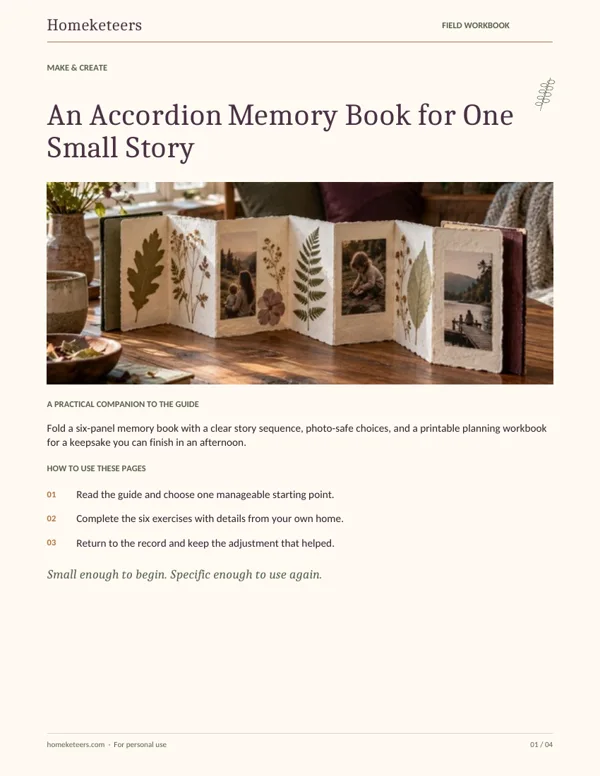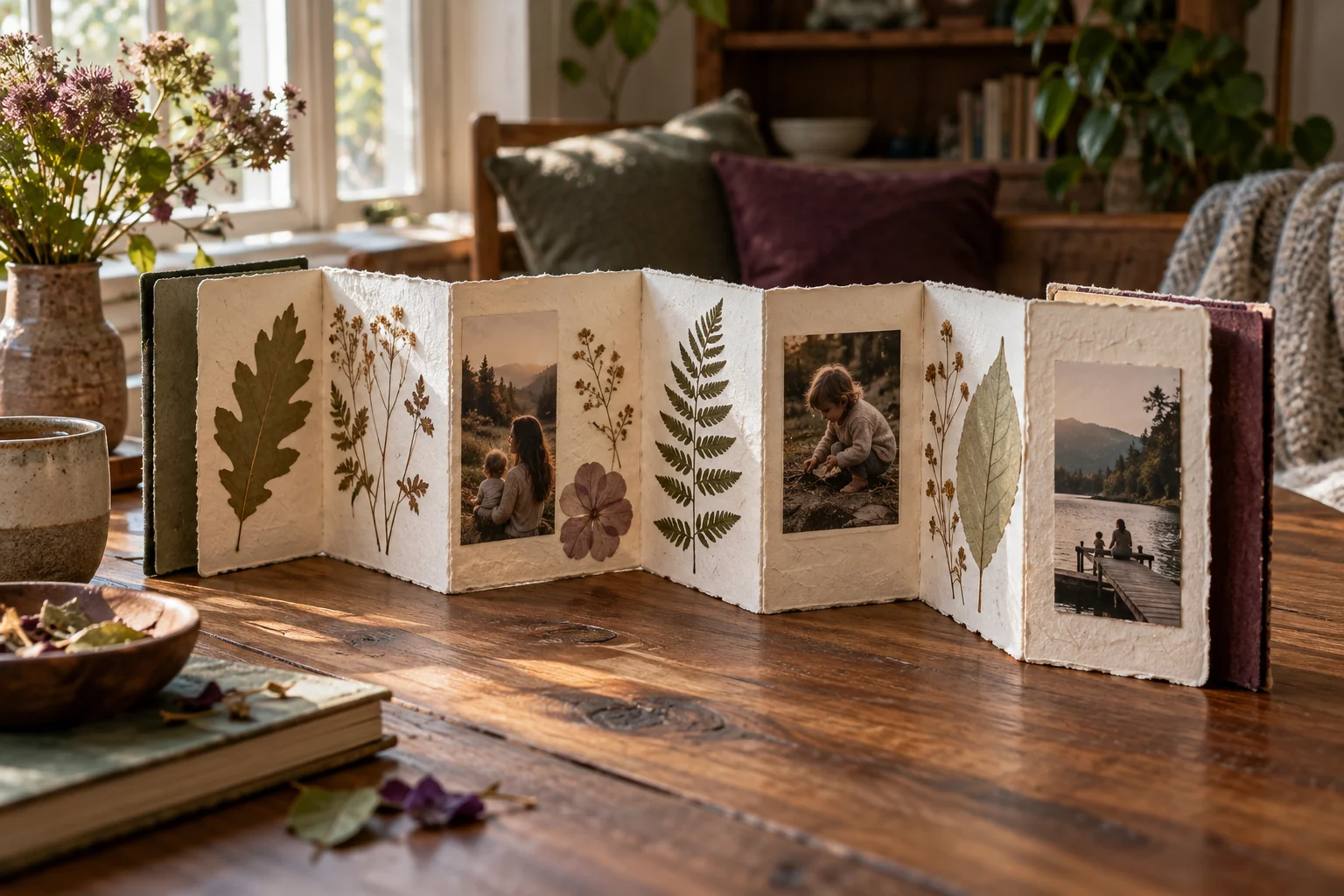
A memory book can become so ambitious that it never reaches the table. You begin with one photograph and soon feel responsible for an entire childhood, a family history, and every person who might be disappointed by an omission. An accordion book offers a smaller container. Six panels can hold one afternoon, one object, one place, or one story someone chose to share.
The Homeketeers six-panel sequence is simple: place, object, moment, voice, meaning, and open question. It gives the book a beginning and an ending without requiring a complete life history. Use copies of photographs and documents whenever possible. A handmade display book is not a substitute for appropriate archival storage of irreplaceable originals.
Choose a story with a boundary
Select a moment that fits a sentence: the day we planted the pear tree, the first meal in this kitchen, or the summer someone taught me to mend. Avoid starting with “our family” unless you are willing to make a much larger book. A bounded subject makes selection easier and protects the project from becoming a record of everything you have not yet preserved.
Ask permission before using someone else's private story or identifiable photograph in a book you plan to share. A gift can still expose information. Consider who will see the book and whether the person represented would welcome that audience. Leave out sensitive details that are not necessary to the chosen story. You can make a meaningful book while preserving someone's right to keep parts of their life private.
Cut and fold a manageable structure
Use a strip of sturdy paper thirty inches long and five inches high, divided into six five-inch panels. If your paper is shorter, join strips with a narrow overlapping tab on the back, keeping the join away from a fold when possible. A first version can be smaller if your available paper is limited; preserve equal panel widths rather than treating these measurements as mandatory.
Mark fold positions lightly with pencil and a ruler. Fold the first panel forward, the second back, and continue alternating. Press each fold with a clean blunt tool. Keep your fingers clear if using a craft knife for cutting, and work on a suitable cutting surface. For a simple version, scissors and careful measuring are enough. Test that the folded stack closes before adding thick decorations.
Plan the six panels before gluing
Place loose copies and text slips on the unfolded strip. Panel one establishes the place or occasion. Panel two introduces the object or image that carries the story. Panel three describes one observable moment. Panel four gives a short quotation with permission or a clearly labeled paraphrase. Panel five names what the memory means to you now. Panel six leaves an honest question or invitation.
This sequence avoids a common keepsake problem: six lovely images with no context. A future reader needs enough information to understand what they are seeing. Add names, approximate dates, and locations where appropriate. If a date is uncertain, say “around 1998” rather than inventing precision. If two people remember an event differently, you can preserve both versions without forcing one into the caption as settled fact.
Use materials that fit the purpose
For a casual display copy, use clean paper, printed duplicates, and an adhesive suited to paper. Apply a thin amount and let it dry before closing the book. If long-term preservation matters, choose materials marketed for archival use and consult appropriate conservation guidance for valuable originals. Avoid assuming that a decorative craft product is safe for every photograph or document.
Pressed leaves can look beautiful but may crumble or mark adjacent paper. A drawn silhouette or scanned leaf image is easier to keep flat. Use embellishments sparingly near folds. A thick button on one panel may prevent the whole book from closing. Test the stack after each addition. The most convincing design often comes from a clear story, repeated margins, and enough empty space for the reader to see each element.
Write captions that add information
A caption should contribute something the photograph cannot supply alone. “Grandma in the garden” may identify the person; “Mara showing me how to pinch basil on the back step, June 2011” adds an action, place, and date. Keep captions short enough to read comfortably. Do not shrink the text to fit a paragraph that belongs in a separate note.
Distinguish memory from interpretation. “I remember feeling welcome” describes your experience. “Everyone was happy that summer” makes a claim about other people that a photograph cannot prove. You can write warmly without flattening a complicated history. A small book becomes more trustworthy when it admits the limits of its viewpoint and leaves space for another person's version.
Finish with a durable, simple closure
Cut two cover boards or heavier paper squares slightly larger than the folded panels if you want a firmer cover. Attach them to the outside faces after checking the fold direction. Add a paper belly band that slides off rather than a permanent ribbon glued across the opening. Write a title and the maker's name with a completion date.
Photograph or scan the unfolded book before gifting it if you want a personal record, provided the subjects have agreed to that use. Keep original files separately with descriptive names. The finished object can then be enjoyed without becoming the only copy of the story. Stop when the six panels communicate what you chose. You do not need to add another volume to justify finishing this one.
Your Homeketeers field workbook: put this guide into practice
The companion workbook is a story map and assembly record. Use it before cutting and again before gifting. It separates selection, permission, captions, and structure so a small creative project can remain small. The six-panel storyboard is also useful if you decide to make a digital version instead of a paper book. The story matters more than the format.
Bound the story
Write the subject in one sentence and list what this book will leave for another project. Name the person who will read it. Choose one moment or object that can carry the sequence. If the subject expands while you work, return to the sentence before adding panels. A deliberate boundary gives the finished book a clearer identity and a realistic ending.
Check permission and copies
List photographs, quotations, and private details you may include. Mark whether you have permission for the intended audience. Identify originals that should be copied and stored separately. Record any restrictions on sharing or photographing the finished book. A keepsake should preserve a memory without taking away another person's choice about how their story circulates.
Map the six panels
Sketch place, object, moment, voice, meaning, and open question in order. Assign one image or text element to each. Keep the first arrangement loose. Check whether a reader unfamiliar with the occasion can follow it. If two panels repeat the same information, give one a different job rather than filling it with another decorative element.
Write useful captions
Draft names, dates, locations, and actions that the images cannot explain alone. Label uncertainty honestly. Distinguish direct quotations from paraphrases and your interpretation from someone else's feelings. Read the captions aloud and shorten any that crowd the page. Comfortable reading size is more valuable than squeezing every remembered detail into a tiny block of text.
Test the paper structure
Record panel size, fold positions, joins, and cover dimensions. Fold an undecorated test and check that the stack closes. Note where embellishments could interfere with folds. Keep a small adhesive test if the paper is unfamiliar. Solve construction problems before attaching photographs, especially when you have only one printed copy available for the final project.
Plan the final handoff
Write the title, maker's name, completion date, and any care or sharing note. Decide whether to make an agreed digital record. Check that the closure can be removed without damaging the panels. Choose a stopping point: six readable panels and a sound structure. Finishing a small book is a meaningful outcome even if the larger family archive remains unfinished.
Keep a record that tells you what actually changed
Open the finished book as a reader rather than as its maker. Can you follow the story without an explanation beside it? Do the folds move easily, the captions remain readable, and the images stay attached? Ask the intended recipient whether any detail should be corrected or kept more private. Record one construction improvement for a future book, then let this one be complete. The project can preserve a particular memory while admitting that no six-panel object contains an entire person or family. Its value lies in the specific story it holds with care.