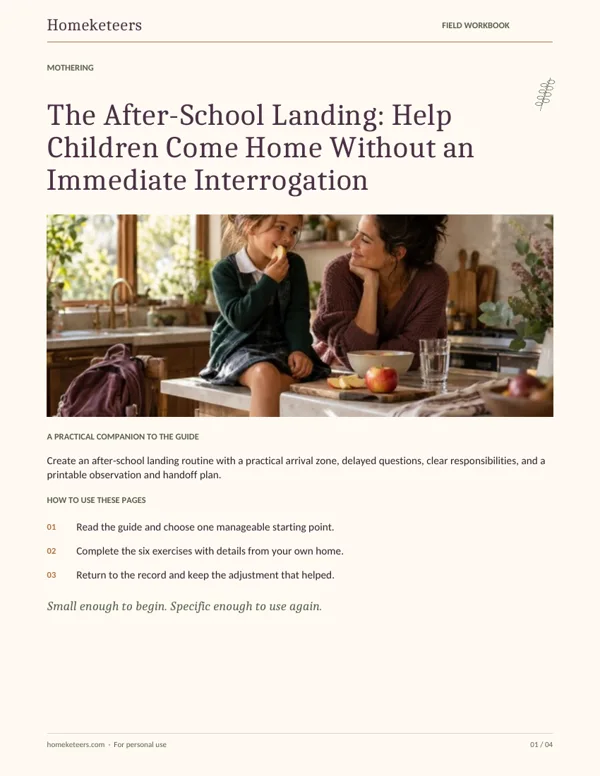
The school door closes, the car door opens, and adults often begin asking questions. What did you learn? Did you finish your work? Why is your jacket missing? A child who has spent hours following instructions may have little conversation left at that moment. An after-school landing gives arrival its own small sequence before the household asks for explanations.
This is an observation-based routine, not a diagnosis of a child's behavior. Some children want to talk immediately. Others want food, movement, silence, or a familiar activity. The Homeketeers Landing Plan helps you notice the pattern while keeping necessary tasks visible. You are making the transition more usable, rather than assuming every child needs the same quiet half hour.
Build a landing zone that can be reached
Choose one place for the backpack, one for shoes or outdoor clothing, and one for items that require an adult response. Put hooks at the child's height and keep the route short. A station on the other side of the house may look neat but fail in practice. Test the actual movement from the doorway instead of deciding by photographs of someone else's mudroom.
Prepare an ordinary snack and water if suitable for the child and consistent with their needs. Avoid making food conditional on recounting the day. If an adult must handle an allergy or other specific care instruction, follow the established plan. The landing routine should simplify the handoff, not create a new food rule.
Ask one arrival question
Try 'Would you like quiet, company, or help right now?' A younger child can choose between two concrete options. A child who does not know can begin with the familiar default. Avoid offering choices you cannot provide, such as complete privacy when another young child needs supervision in the same room.
If they start talking, listen without turning the first sentence into a full investigation. If they say nothing, give a clear later check-in: 'I will ask about anything that needs my help after your snack.' This protects necessary communication while releasing the pressure to produce a satisfying school report at the door.
Give responsibilities a place in the sequence
Arrival is not a permanent exemption from ordinary tasks. Decide whether lunch containers are emptied before or after the first break. Use the same simple order for several days: belongings land, hands washed as appropriate, snack, short chosen activity, then required handoff. Adjust the timing to the family's actual schedule, including transport to activities or the adult's work.
A child who is routinely too tired to complete a particular task may need the task divided or moved. 'Empty the entire bag and organize every paper' can become 'place the lunch container here and papers in this tray.' Teach the sequence at a calm time. Repeated instructions during a difficult arrival rarely reveal which part is too complicated.
Separate urgency from adult curiosity
A safety concern, an illness, a time-sensitive message, or an immediate care need should be addressed promptly. Ordinary curiosity can wait. Make this distinction visible in your own notes. 'I wanted to know the spelling score' is different from 'the school sent a message that needs a response today.' Both can matter without needing the same timing.
Later, choose a narrow opening: 'What was one part of today that was easier or harder than yesterday?' Or ask about something the child has already mentioned. Do not insist on a positive answer, and do not use the check-in to extract information about other children's private lives. You are available for the child's experience, not collecting a complete transcript.
An illustrative arrival experiment
A mother notices her eight-year-old argues about homework whenever it is mentioned in the car. For five days, they use a landing sequence with water, a simple snack, and ten minutes of drawing. The lunch container lands before drawing; homework decisions happen afterward. The mother records the actual start time and whether help was requested.
The first two days are still difficult. On the third day, the child asks to draw beside her instead of alone. The plan changes accordingly. This is not proof that a single routine solves school stress. It is useful evidence about the timing and kind of support that this particular child accepts. Keep the experiment modest enough to notice those details.
When the landing does not help
Check the obvious dependencies: hunger, a rushed departure from school, unclear expectations, or an activity scheduled too soon after arrival. Ask the child what part feels difficult. Persistent concerns about school, health, or safety deserve appropriate attention beyond a household routine. Do not interpret a quiet child as automatically fine or a loud child as automatically defiant.
A good landing protects a short transition and makes the next handoff clear. It should reduce repeated instructions, not create an elaborate ritual you must perform perfectly. Let home feel like a place where someone can arrive as they are, then find the support and responsibilities waiting in an understandable order.
Your Homeketeers field workbook: put this guide into practice
The Landing Plan workbook turns an abstract hope for calmer afternoons into a five-day observation. Record arrival time, the first request, the available adult, and the required handoff. Keep the child's private disclosures separate. The worksheet is for improving the household sequence, not rating the child's mood or rewarding a quiet performance.
Map the actual doorway route
Draw the route from entrance to backpack, shoes, and food or water. Mark any point that requires searching or reaching beyond the child's ability. Move one item closer before buying a new storage unit. Record who resets the station and where wet or dirty belongings go. A landing point without an overflow rule quickly becomes another pile.
Choose the first ten minutes
Offer quiet, company, or a simple familiar activity that is possible that day. Write the default and one alternative. Include the adult's availability rather than promising uninterrupted time during a work call. Let the child revise the preference. Their answer may change across the week, and that is information about the day's needs rather than failure to follow the plan.
Place necessary tasks in order
List the smallest required handoff: lunch container, adult-action papers, or a time-sensitive school item. Decide whether it happens before or after the first break. State what counts as finished. Teach the order outside the rushed arrival window. If a task repeatedly causes conflict, inspect its size and timing before adding more reminders.
Write the later conversation opening
Choose a specific, open question that leaves room for an honest answer. Write when you will ask it and what will happen if the child is not ready. A later walk, supper preparation, or quiet car ride may work. Keep an urgent concern outside this delay. Privacy, health, and immediate safety should not wait for the routine's preferred conversation slot.
Track one useful observation each day
Record what happened rather than a character label. 'Started homework after drawing with one reminder' is useful. 'Finally behaved' is not. Note an interruption, unexpected hunger, or schedule change. These details help you distinguish a poorly timed task from a broader concern. Do not ask the child to monitor themselves for the sake of producing a successful-looking worksheet.
Agree on the next handoff
At the end of the landing period, name the next responsibility and the available support. Example: 'Now we check what is due, and I can help for fifteen minutes.' Make the limit honest. If an activity requires departure, decide the warning time in advance. A clear ending protects the transition from becoming an undefined period that leaves everyone unsure what happens next.
Keep a record that tells you what actually changed
After five days, look for a repeatable sequence, not a perfect afternoon. Did belongings land in usable places? Did the necessary handoff happen? Did the child have a recognizable opportunity to choose quiet or company? Keep the parts that reduced friction and adjust one persistent obstacle. If the family schedule prevents a long break, preserve a smaller landing with the same clear beginning and end. Add the child's wording to the plan so the routine sounds like your household. A useful arrival system is one the child can understand and the adult can actually maintain.