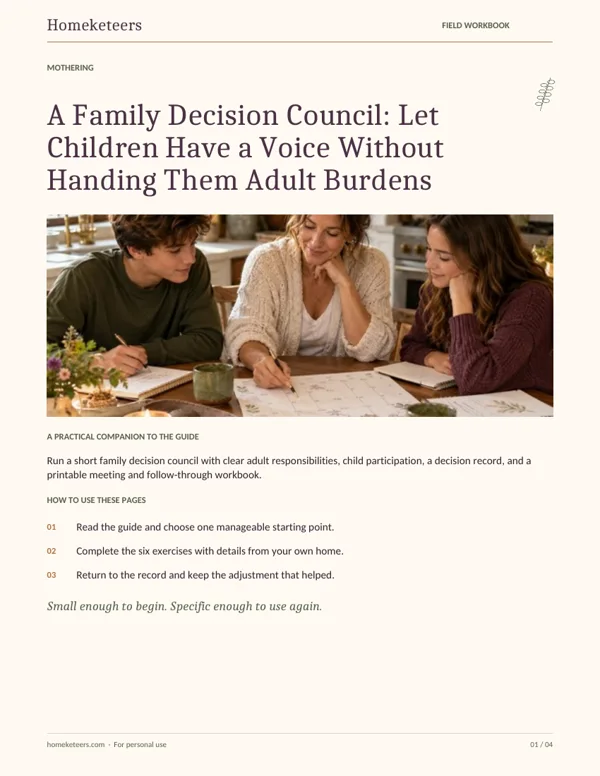
A family meeting can become a place where one adult announces instructions while everyone else waits to leave. It can also become an exhausting negotiation about decisions children should not have to carry. A useful family decision council makes the boundary visible: adults remain responsible for safety, care, finances, and legal obligations; children receive a meaningful voice in choices that genuinely have room for one.
The Homeketeers council uses one question, a small set of feasible options, and a written decision. You might choose how to share a common work surface, plan a weekend at home, or assign a routine household task. Do not open a discussion about whether essential care will happen, whether bills will be paid, or whether a child must solve an adult relationship problem. Participation is valuable when the available choices are real.
Define the decision before inviting people
Write the question in one sentence. 'How can everyone use the kitchen table after school?' is workable. 'Why does nobody help me?' is an understandable frustration but not a decision question. Identify what cannot change: supper needs the table at six, work materials must be protected, and nobody can damage another person's belongings.
List what can change: time slots, a portable project tray, the cleanup signal, or an alternative surface. If you have already decided the outcome, explain it as an adult decision instead of staging a consultation. Children notice when their participation changes nothing, and a pretend vote teaches the wrong lesson about having a voice.
Give everyone a low-pressure way to contribute
Ask for one difficulty and one workable suggestion. A younger child can draw their idea. A teenager can write it before the conversation. Someone who does not want to speak can pass. Do not require a child to defend a preference in front of a sibling who routinely interrupts them. The adult can summarize the idea and check whether the summary is accurate.
Choose a short time limit, such as fifteen minutes, and discuss one question. If people are hungry, distressed, or leaving in five minutes, reschedule. The council is not an emergency courtroom. Serious concerns need an appropriate private conversation or other support, rather than a family vote.
Compare options against the same constraints
For each proposal, ask: does it fit the available time, preserve necessary care, and have a clear owner? Avoid dismissing a child's idea because it sounds unusual before examining whether it solves the problem. A tray for a half-finished model may be more practical than telling its maker to dismantle it every night.
Adults can veto an unsafe or impossible option, but explain the relevant constraint in age-appropriate terms. 'The cost is beyond the amount available' is clearer than 'Because I said so' when money is the deciding factor. You do not need to disclose private financial details to demonstrate that a boundary is real.
Choose a trial rather than a permanent rule
When more than one option is reasonable, try one for a week. State the action, owner, start time, and review date. A majority vote is not always appropriate: a popular option can place an unfair burden on one person. The adult should check who will do the work and whether that person has a realistic way to do it.
An illustrative council: two children use the table for art and homework while their mother prepares supper. They agree that art stays on a portable board and homework gets the table first for twenty minutes. The art board moves to a shelf at five-thirty. The mother owns the departure warning, and each child owns their materials. They review the trial the following Sunday.
Follow the decision into ordinary life
Put the decision where it is used. A table agreement belongs near the table, not hidden inside a meeting notebook. Use one brief reminder during the first few days. If the plan repeatedly fails, record the reason. The shelf may be too high, the homework window may be too short, or the adult's warning may occur during a work call.
Keep repair separate from punishment. 'The board does not fit the shelf; we need another location' is a design problem. Deliberately damaging another person's work is a behavior problem requiring an adult response. Treating every failure as disobedience makes the council less useful, while treating every harmful action as mere logistics avoids necessary responsibility.
End with a decision children can recognize
Read the agreement aloud and invite corrections to the wording. Ask each person what they are responsible for, rather than asking whether they promise to be helpful. Thank them for a specific contribution. Then end. There is no need to add a lesson, a gratitude exercise, or several unrelated household complaints.
At review, the adult remains responsible for the final workable arrangement. Children can help identify the next adjustment. A good council gives people practice in naming needs, understanding limits, and keeping a shared agreement. Its value comes from what happens after the conversation, not from how impressive the family meeting looks on paper.
Your Homeketeers field workbook: put this guide into practice
The Family Council workbook has one decision spread and a one-week follow-through grid. Use it for a choice that genuinely permits participation. The adult-responsibility panel comes first so children do not receive a burden disguised as empowerment. Keep meetings short and let the written record carry the agreement between conversations.
One decision with real room for choice
Write the question and the reason it matters this week. Remove accusations and unrelated problems. List which parts are fixed by safety, care, money, or schedule. Then list the choices that are actually available. If there are no meaningful choices, prepare a clear adult explanation instead of calling a council that cannot change the outcome.
Each person's need and proposal
Give each person space for one difficulty and one suggestion. Allow writing, drawing, or passing. Record the speaker's own wording before interpreting it. Check a summary with them. Do not force a child to disclose private matters to justify a preference. The council concerns the shared decision, not an audit of everything each person feels.
Compare the options fairly
Use the same three checks for every idea: feasible, safe, and clear ownership. Add the practical consequence for the person who will do the work. A popular option may still be unfair if it gives one person every reset task. Identify any purchase or outside dependency. Eliminate unavailable options before asking children to choose among them.
Write a trial agreement
Record the chosen action, who owns it, when it begins, and the review date. For the table example, name the portable board's exact resting place and the time it moves. Replace vague words such as 'soon' or 'help more' with visible actions. The agreement should be short enough for the child who uses it to explain it back.
Record failures without rewriting history
Make a brief note each day: kept, partly kept, or blocked by a specific condition. Include the adult's missed handoff as honestly as the child's. Do not revise the original agreement to make a later complaint look like something everyone already accepted. A clear baseline helps the review produce a repair rather than another argument about what was said.
Review and choose one adjustment
Ask what worked, what was difficult, and which single change would improve the next week. Keep necessary limits intact. If the trial cannot work, end it explicitly and choose another feasible arrangement. A child can contribute useful information while the adult makes the final responsibility check. Record the updated agreement so nobody has to rely on competing memories.
Keep a record that tells you what actually changed
A week later, check whether the council produced an understandable decision and whether its owner could carry it out. Count follow-through rather than meeting attendance. Notice who needed reminders and who carried invisible reset work. Adjust the plan if the burden was uneven. Keep a short archive of decisions that worked, because the same household problem may return in a new form. Do not promise that family councils prevent conflict. They provide a way to handle a limited practical question with clearer participation, limits, and accountability. That is a substantial contribution to family life on its own.