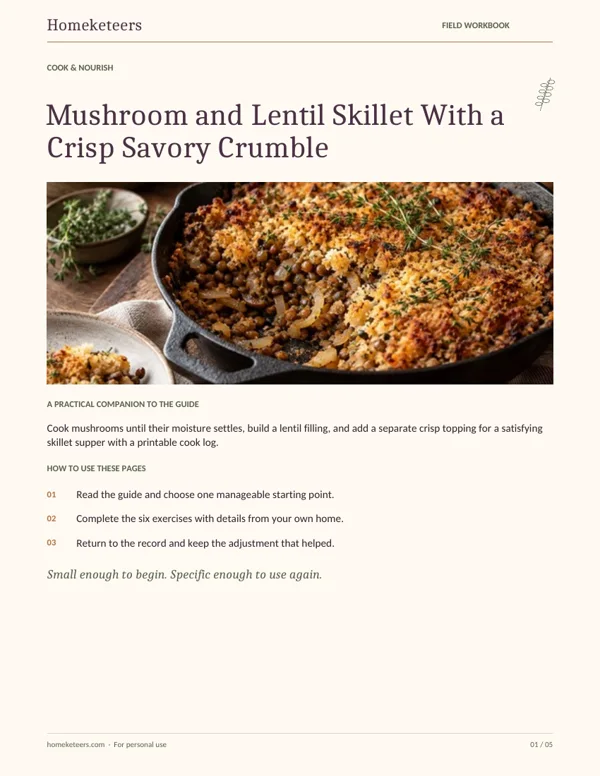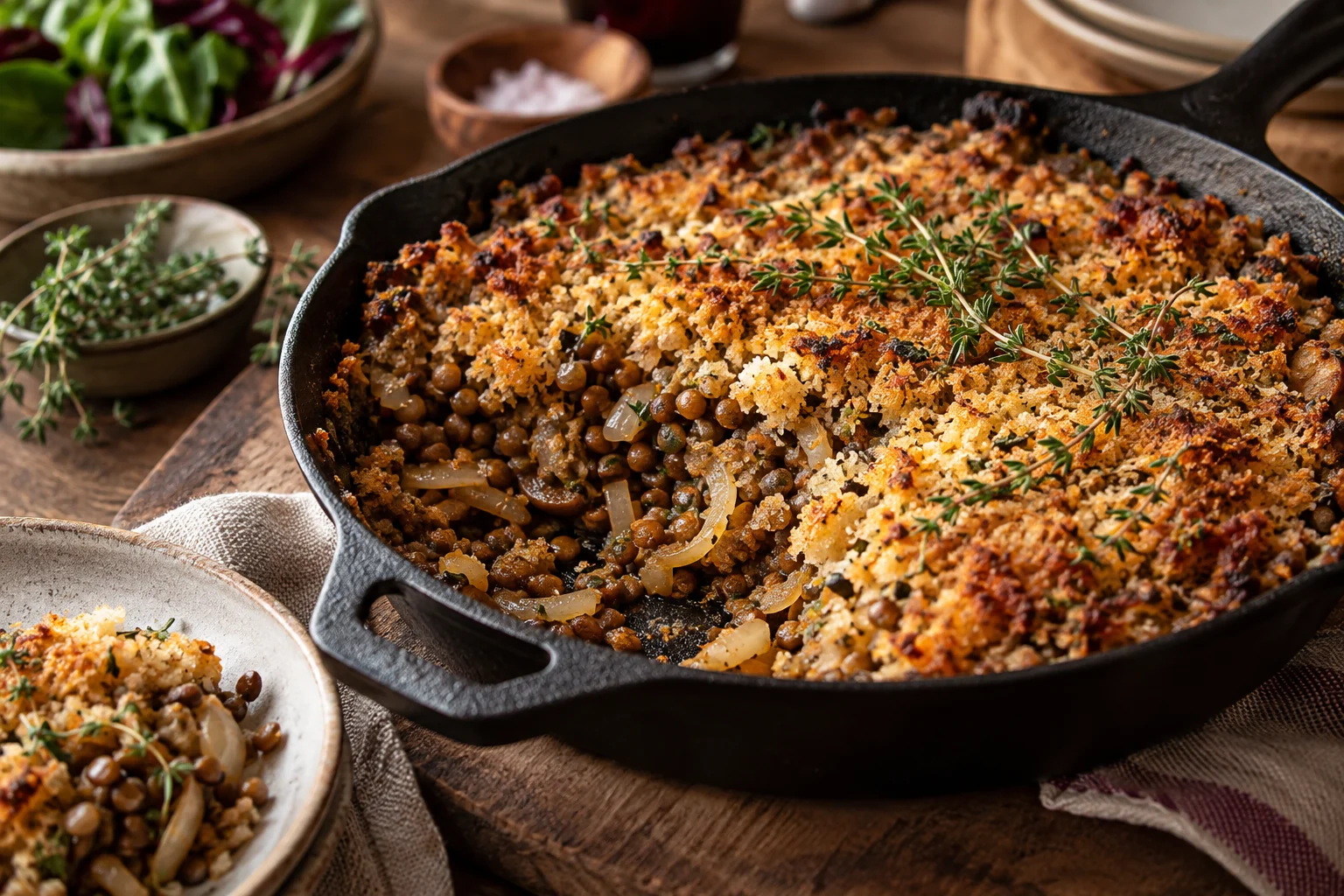
A vegetable skillet can lose its appeal when the filling is watery and the topping absorbs everything beneath it. This mushroom and lentil supper solves those two problems separately. Mushrooms cook until their released moisture has mostly evaporated. A broth-and-lentil filling becomes spoonable, then a toasted crumble goes over the finished skillet just before serving. The contrast is built into the sequence.
The Homeketeers separate-crisp method is especially useful for households that eat at different times. Keep some topping in a small dry container and add it to each reheated portion. The person eating later gets the same intended texture rather than inheriting a soggy layer. It is a small operational choice that makes a comforting supper work beyond one photograph.
Ingredients for four servings
For the filling, use 12 ounces cultivated edible mushrooms, wiped clean and sliced; 1 medium onion, chopped; 2 carrots, diced small; 3 garlic cloves, chopped; 2 tablespoons olive oil; 1 tablespoon tomato paste; ½ teaspoon dried thyme; 3 cups cooked brown or green lentils, drained; ¾ cup low-sodium vegetable broth, plus more as needed; 1 tablespoon soy sauce or a suitable labeled alternative; and black pepper. Taste before adding salt because broth and soy sauce vary substantially.
For the crumble, use ¾ cup coarse breadcrumbs, 1 tablespoon olive oil, 2 tablespoons finely chopped parsley, and an optional 2 tablespoons grated Parmesan. Omit the cheese for a dairy-free version. If using gluten-free breadcrumbs or a soy-sauce alternative, check the product labels and texture. The recipe is adaptable, but those substitutions do not automatically make it suitable for every allergy.
You need a wide skillet, a second small pan for the topping, and a spoon. Plan about twenty minutes for preparation and twenty-five to thirty minutes for cooking when the lentils are already cooked. If starting with dry lentils, cook them separately according to their type and package directions, then measure the cooked quantity. Do not add dry lentils to this filling and expect the stated broth amount to hydrate them.
Prepare the lentils and vegetables before starting
Drain the cooked lentils thoroughly. Canned lentils can work; rinse and drain them, then measure about three cups. Brown and green lentils tend to keep more structure than red split lentils. A softer lentil makes a different filling, so choose based on the texture you want. Remove any debris if cooking from dry and follow the package guidance.
Cut the carrots small enough to soften within the skillet cooking time. Thick carrot chunks can remain hard while the mushrooms are already finished. Slice the mushrooms to a similar thickness. Use known cultivated edible mushrooms from a reliable food source. This recipe is not a reason to cook unidentified wild mushrooms, and visual resemblance is not an adequate food-safety check.
Cook mushroom moisture as its own stage
Warm 1 tablespoon olive oil in the wide skillet over medium-high heat. Add the mushrooms in a layer that allows some contact with the pan, cooking in batches if necessary. Stir occasionally and let their released moisture mostly evaporate. Continue until they are softened and beginning to brown, roughly eight to twelve minutes depending on the pan and mushroom batch.
If the skillet fills with liquid, allow time for evaporation rather than adding breadcrumbs to absorb it. A crowded pan takes longer. Keep the heat high enough to cook steadily but reduce it if the pan scorches. Transfer the mushrooms to a plate once this stage is settled. You are preserving their flavor and texture while making room to soften the firmer vegetables.
Build the filling without burying the vegetables
Add the remaining tablespoon of oil, onion, and carrots to the skillet. Cook over medium heat for about eight to ten minutes, stirring, until the carrots are nearly tender. Add garlic, tomato paste, and thyme. Cook for about one minute, stirring so the tomato paste warms and the garlic does not burn. Add a splash of broth if the pan needs deglazing.
Return the mushrooms and add the drained lentils, remaining broth, and soy sauce. Simmer gently for five to eight minutes, stirring, until the carrots are tender and the filling is cohesive. It should be moist and spoonable, with no large puddle at the edge. Add broth a little at a time if too dry. Simmer uncovered a little longer if too loose.
Toast the crumble separately
While the filling simmers, warm the crumble oil in a small pan over medium heat. Add the breadcrumbs and stir until golden and crisp, usually three to five minutes. Watch closely because the final change from pale to burnt can happen quickly. Transfer them to a bowl and let the steam escape. Stir in parsley and optional Parmesan shortly before serving.
Do not cover the hot crumbs tightly while steam is still rising; condensation can soften them. Keep them away from the simmering filling until the meal is ready. If you prefer an oven-finished presentation, use an oven-safe skillet and an appropriate method, but the separate stovetop topping is the simpler route and avoids another appliance step.
Taste through a clear sequence
First check the carrot tenderness. Then taste the filling for salt and savory depth. Add a small amount of soy sauce or salt only if needed. Pepper belongs after you can judge the base. If the flavor feels heavy, a few drops of lemon or vinegar tested in a spoonful may brighten it, but acidity is optional and should not replace proper seasoning.
Scatter some crumble over the skillet or add it to individual bowls. Keep a portion separate for anyone eating later. A simple green vegetable or salad can complete the table if you want contrast. The lentils provide a substantial base, but serving size and household appetite still matter. Do not describe one pan as a complete answer to every dietary need.
A worked example for staggered meals
Rae cooks the skillet before a child's evening activity. Two people eat immediately, and one will return an hour later. She serves the first bowls with crumble, then refrigerates the remaining perishable filling promptly rather than leaving it on the stove until everyone is home. The late portion reheats separately and gets its topping afterward.
Her workbook notes that canned lentils needed no extra broth beyond the starting amount, while the mushrooms required an extra few minutes to lose their moisture. The next cook starts with those observations. She has not changed the dish into something new; she has made the sequence fit her ingredients and the evening's timing.
Store filling and topping with different goals
Refrigerate perishable leftovers within two hours, or within one hour when the surrounding temperature exceeds 90°F. Use shallow containers, keep the refrigerator at 40°F or below, and use refrigerated leftovers within three to four days or freeze them. Reheat the filling to 165°F, checking with a food thermometer. Add a splash of broth if it thickens during storage.
Refrigerate the prepared herb or cheese crumble separately as a perishable component and use within the same practical storage window. Re-crisp it in a pan if needed. For longer storage, freeze the filling and make fresh topping when serving. Texture and safety are different decisions; a dry-looking crumb is not a reason to ignore the fresh ingredients mixed into it.
Your Homeketeers field workbook: put this guide into practice
Keep the companion kitchen workbook beside the stove. It includes the recipe quantities, a preparation sequence, and spaces for the adjustments that make this meal work in your own kitchen. Record the result before changing several ingredients on the next cook.
Confirm cooked lentils
Record lentil type, source, cooked measure, and drainage. If cooking from dry, add the separate cook time to your plan. Note any softness that will affect the filling. Keep the ingredient role clear: this recipe begins with cooked lentils, not a dry quantity awaiting hydration in the skillet.
Set the mushroom endpoint
Record mushroom type, pan size, batch count, and the time the released liquid mostly evaporated. Note browning without burning. This stage determines whether the filling begins with flavorful mushrooms or a watery base. Use the observed endpoint rather than forcing every batch to match the shortest time.
Check the vegetable preparation
Draw or describe the carrot dice and mushroom slice size. Record when the carrots become tender. Note garlic and tomato-paste timing. A preparation record is especially helpful if one component stays hard while the rest is ready, because the next correction may be cutting size rather than extra seasoning.
Adjust the filling consistency
Record starting broth, additions, simmer time, and whether liquid puddled at the edge. Test salt after the soy sauce and broth have concentrated. Keep the final description concrete: moist and spoonable, with tender carrots. This helps you repeat the texture without using breadcrumbs to hide excess liquid.
Protect the crisp topping
Record breadcrumb type, toast time, and when herbs or cheese were added. Mark the portion kept separate for later diners. Plan how it will be stored and re-crisped. The topping is a distinct component, so its texture should have its own decision instead of inheriting the filling’s schedule.
Map staggered meals safely
Write who eats when, how many portions remain, and when the filling will be refrigerated. Keep the original storage date when reheating. Record the temperature check and any broth added. A staggered-meal plan should protect the later portion without leaving perishable food out for convenience.
Keep a record that tells you what actually changed
After the meal, compare the filling and topping separately. If the filling was loose, revisit mushroom moisture and broth. If the topping softened, revisit when it met steam. Choose one correction for the next cook and keep the rest stable. A recipe that remains pleasant for the person eating later has already earned its place in an ordinary household.