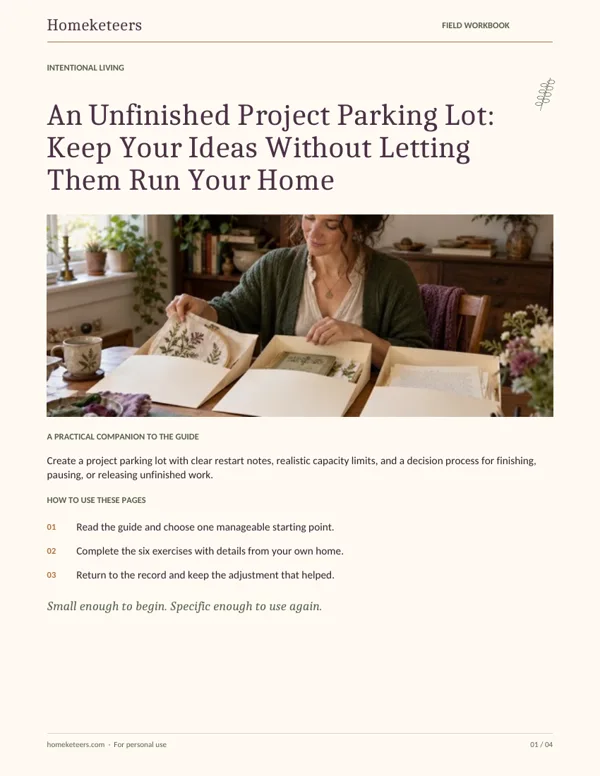
The half-sewn cushion is not only fabric. It is an unfinished decision. So are the recipe you intended to photograph, the garden bed you wanted to build, and the stack of family pictures waiting for an album. When every project stays visible, the house becomes a room full of requests. You can keep your creative life without treating every idea as a current obligation.
The Homeketeers project parking lot has three destinations: active, parked, and released. Active work gets usable time and space. Parked work gets a complete restart note and a review date. Released work gets a deliberate ending. Nothing needs a judgment about whether you are a creative person. You are deciding which work can fit into the life you have now.
Inventory by project, not by object
Name the outcome, not the material: 'repair the blue cushion,' rather than 'fabric pile.' Gather the pieces that belong to that outcome. Include physical supplies, digital files, instructions, and commitments to other people. A project scattered across three baskets and two browser tabs is harder to restart because the first task becomes reconstruction.
Write the current stage and the next physical action. 'Finish quilt' is not an action. 'Cut six backing squares using the paper template' is. If you cannot identify the next action, your first action is a short investigation: open the pattern, inspect the missing part, or decide the dimensions. Do not disguise an unresolved design choice as a simple task.
Choose a capacity you can demonstrate
Look at the next two weeks, including work, school, caregiving, and recovery time. Find actual creative windows. Two forty-minute blocks are eighty minutes, not an imaginary free weekend. Reserve a little of that time for finding supplies and cleanup. Then choose one main project and, if useful, one small portable project. More is possible only when the calendar supports it.
A visible work-in-progress limit protects the project you want to finish. It also makes 'not now' less personal. When a new idea appears, record it in the parking lot instead of moving the active project's materials off the table. An idea remains yours even when you decline to work on it this week.
Build a restart packet
Every parked project needs its name, purpose, completed work, next action, missing supplies, file locations, and a photograph of its current state. Put the note with the materials. For digital work, place a short README-style note in the project folder. Keep the folder name human-readable. 'Autumn recipe booklet, paused after layout' is better than a date followed by random numbers.
Give the packet a review trigger: after the school term, when the sewing machine returns, or on a specific calendar date. A trigger is permission to reconsider, not a promise to finish. Record any practical deadline. A costume for a child who has outgrown it should not compete with a project that still serves someone.
Use a finish, reduce, park, release decision
Finish when the next action is clear, the outcome still matters, and capacity exists. Reduce when a smaller outcome would still be useful: four cushion covers can become one repaired cover. Park when the work matters but its time has not arrived. Release when the purpose has expired, materials are damaged, or continuing would serve only the discomfort of abandoning it.
An illustrative example: a mother began an elaborate family scrapbook before moving house. She now wants the photographs available, but she no longer wants decorative page layouts. She reduces the project to a labeled photo box and six favorite pages. The remaining craft supplies are released for another person's use. The family memory survives; the original format does not have to.
Close the loop when you release
If someone is waiting, send a clear ordinary update yourself. If no one is waiting, make a note of the decision and remove the supplies from the active space. Avoid selling every leftover item if listing, messaging, and shipping would create another project. Choose the disposal or donation route that is lawful, suitable for the materials, and actually achievable.
Keep a learning sentence: 'I enjoyed choosing the fabric, but not sewing sixteen identical pieces.' That observation can sharpen your next project. Do not turn it into a permanent label such as 'I never finish anything.' A project is a particular fit between purpose, method, and circumstances.
Restart without recovering the entire past
When the review trigger arrives, read the packet and inspect the materials. Confirm the outcome still matters. Test one small next action for fifteen minutes. If the packet is incomplete, add the missing information before making it active. You should not need to remember who you were six months ago to continue today's work.
Protect one clear work surface. Place only the active project's next-use materials there. The parking lot belongs elsewhere, contained and labeled. This separation is what turns storage into a usable creative system: your ideas remain available, while your current attention has somewhere to land.
Your Homeketeers field workbook: put this guide into practice
The Project Parking Lot workbook asks for evidence rather than a motivational promise. Use one spread per project, then a short capacity sheet for the whole collection. The example fields below follow a family scrapbook. They show how a creative intention can survive a change of format without keeping every unfinished supply active.
Project identity and current purpose
Write an outcome someone could recognize: a photo collection my children can browse. Describe why it matters now, who will use it, and where it will live. Avoid using the original purchase as the reason to continue. Money already spent cannot supply future time. Record a sentence about the desired experience, such as being able to find a birthday photograph without searching five phones.
State of the work and missing information
List what is finished, what remains undecided, and where the parts are. Example: fifty prints sorted; twelve envelopes unlabeled; digital backups on the family drive; album dimensions undecided. Add a photo of the physical pile. This record should let you resume without retelling the whole history. If a file location is unclear, finding it is an investigation task before any design work.
The next two weeks of capacity
Enter dates and realistic minutes, not general intentions. Include setup and cleanup. For the scrapbook, two thirty-minute blocks might be enough to label envelopes but not build an entire album. Mark any block that depends on another person's cooperation. Leave ordinary rest time unassigned. A plan that consumes every spare minute is especially vulnerable when one school or work obligation changes.
Finish, reduce, park, or release
Choose one destination and write the reason. A reduced version might be six completed pages plus a sorted photo box. Parked work needs a review date and restart note. Released work needs a supplies exit plan. If you are undecided, compare two outcomes using the same available time. Select the version that preserves the meaningful purpose with the fewest unresolved dependencies.
A complete restart note
Record the next physical action, supplies already present, supplies missing, and the exact location of the instructions. For the photo box, the next action is to label the first five envelopes by year. Include the label format so you do not reopen that decision later. Put the note inside the box or at the top of the digital folder, where the next session naturally begins.
A review trigger with an exit option
Choose a calendar date or a specific event such as the next school break. Write what would make the project active again and what would make release reasonable. Example: continue if the children still want the album and two real sessions exist; release decorative layouts if they still create avoidance. The review should reopen the decision, rather than automatically renewing a debt to the old plan.
Keep a record that tells you what actually changed
After two weeks, record the number of active projects, the time actually used, and one finished or deliberately reduced outcome. Count a clear release as a resolved decision, while keeping it separate from a completed object. Notice whether the active project stayed accessible between sessions. If the work surface still accumulated unrelated materials, change the storage location or lower the active limit. Keep the restart notes even for completed projects; they can become useful instructions if you repeat a technique. A successful parking lot makes creative work easier to resume and easier to decline. It does not require every idea to become a product, a gift, or a public achievement.