
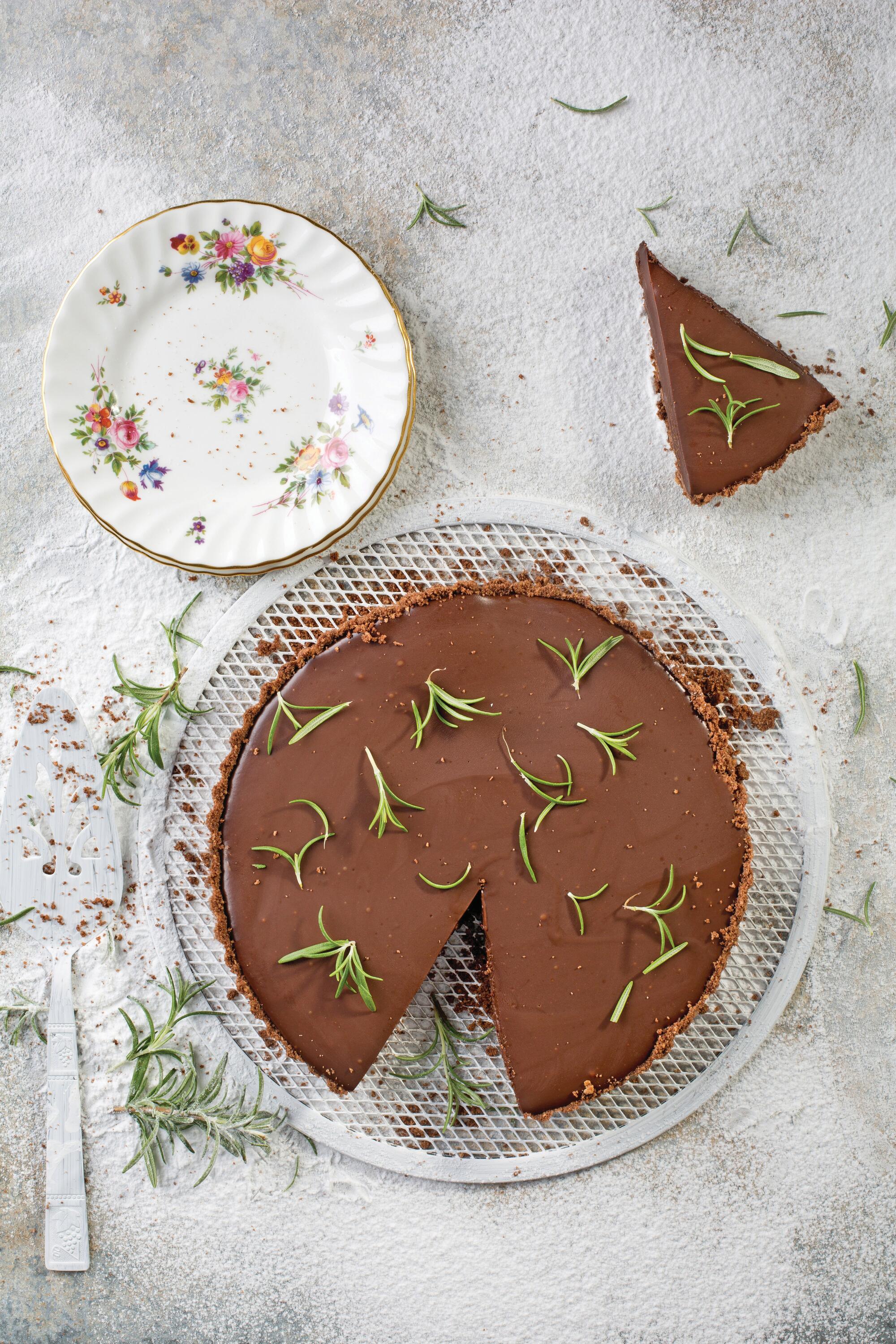
The Story & Hearth Inspiration
Chocolate does not need much help, which is why the things paired with it matter. Rosemary is unexpected until you taste it. The herb does not make the tart savory. Instead, its piney fragrance sharpens the chocolate and keeps a rich slice from feeling flat or overly sweet. Olive oil and sea salt do the same work from different directions.
This is the dessert I make when I want something that looks deliberate without spending the afternoon piping frosting. The crust is pressed directly into the pan. The filling is ganache, which sounds technical but is simply hot cream and chopped chocolate handled with a little patience. The refrigerator does the final work.
Rosemary carries old associations with remembrance, clarity, and protection, and cacao has long cultural histories that are much richer than the modern shorthand of calling chocolate “heart medicine.” Here I prefer to keep the language grounded. The ritual is sensory: crush a rosemary needle between your fingers, smell the cream as it steeps, watch dull chopped chocolate become glossy. Attention itself can make an ordinary kitchen act feel sacred.
Flavor & Ingredient Notes
Use a dark chocolate you genuinely like eating. Around 70 percent cacao gives a filling that is intense but still balanced by cream. Much darker chocolate can produce a firmer, more bitter ganache. Chop bars finely and evenly so the cream melts them without aggressive whisking.
The rosemary infusion should be fragrant, not medicinal. Three modest sprigs in one cup of cream is enough. Bring the cream only to steaming, remove it from the heat, cover, and taste after fifteen minutes. If the rosemary is already clear, strain it. Twenty minutes is usually the upper limit I prefer.
The crust can be made with all-purpose flour for a classic pastry texture or almond flour for a more tender, nutty base. Because different flours absorb oil differently, judge the dough by feel. It should hold when squeezed and press cleanly against the tart pan without pooling oil.
Flaky salt belongs on top after the ganache is poured. Fine table salt disappears and can make the tart taste uniformly salty. A few visible flakes create contrast bite by bite.
Step-by-Step Cooking Guide
Start with the crust and give it time to cool completely. Mix flour, olive oil, maple syrup, and salt until evenly moistened. Press the mixture firmly across the bottom and up the sides of an eight-inch tart pan. Use the flat bottom of a measuring cup to compact it. Bake until the edges take on color, then cool on a rack.
For the ganache, place finely chopped chocolate in a heatproof bowl before you heat the cream. Add rosemary to the cream and bring it just to the point where steam rises and tiny bubbles appear at the perimeter. Do not boil it hard. Cover off heat, steep, then strain. Rewarm briefly if needed.
Pour the hot infused cream over the chocolate and leave it untouched for two full minutes. Begin stirring in the center with a small whisk or spatula, making tight circles. The mixture will become glossy as the emulsion forms. Stir outward only after the center is smooth.
Pour the ganache into the cooled crust and tap the pan lightly to release air bubbles. Sprinkle with flaky salt while the surface is still fluid. Refrigerate until set, generally two hours. For the cleanest slices, use a thin knife warmed under hot water and wiped dry between cuts.
Salted Dark Chocolate & Rosemary Tart
Prep: 25 minutes | Bake: 12 to 15 minutes | Chill: 2 hours | Yield: 8 to 10 slices
Ingredients
- 1 1/2 cups all-purpose flour or fine almond flour
- 3 tablespoons extra-virgin olive oil, plus more if needed for almond flour
- 2 tablespoons pure maple syrup
- 1/4 teaspoon fine sea salt
- 8 ounces 70% dark chocolate, finely chopped
- 1 cup heavy cream
- 3 small fresh rosemary sprigs
- Flaky sea salt, for finishing
- Optional: 1 teaspoon vanilla extract
Instructions
- Heat oven to 350°F. Mix crust ingredients until the mixture holds together when pressed.
- Press evenly into the bottom and sides of an 8-inch tart pan. Prick the base lightly with a fork.
- Bake 12 to 15 minutes until lightly golden at the edges. Cool completely.
- Put chopped chocolate in a heatproof bowl.
- Heat cream and rosemary until steaming. Remove from heat, cover, and steep 15 to 20 minutes. Strain.
- Reheat cream just until hot if necessary, then pour over chocolate. Wait 2 minutes.
- Stir gently from the center outward until glossy. Stir in vanilla if using.
- Pour into cooled crust and finish with flaky salt. Refrigerate about 2 hours until set.
Cook's Notes
Do not substitute coconut cream in this Homeketeers version. Heavy cream gives the intended set and flavor. Keep the tart refrigerated up to four days. Let slices stand at room temperature for 10 to 15 minutes before serving for the silkiest texture.
Serving the Tart
A narrow slice is enough. Serve it plain, with barely sweetened whipped cream, or with tart berries. Blackberries and raspberries are particularly good because their acidity interrupts the richness. A drizzle of fruity olive oil is beautiful if your oil is mild rather than aggressively peppery.
For a gathering, make the tart the day before. It removes dessert from the last-minute work entirely. Garnish shortly before serving with a few rosemary leaves, berries, or toasted hazelnuts, but keep the top restrained. The glossy dark surface is part of what makes the tart dramatic.
Why This Combination Works
Rich desserts need contrast. Chocolate supplies bitterness, sweetness, and fat. Cream softens the cacao. Rosemary contributes aroma rather than bulk. Salt increases perception of the chocolate's complexity, while the olive oil crust has a subtle fruitiness and a cleaner finish than a very sweet cookie crust.
That balance is what makes this feel like hearth food rather than restaurant theater. It is luxurious, but it is made from a short list of recognizable ingredients and a process that can happen between the rest of ordinary life.