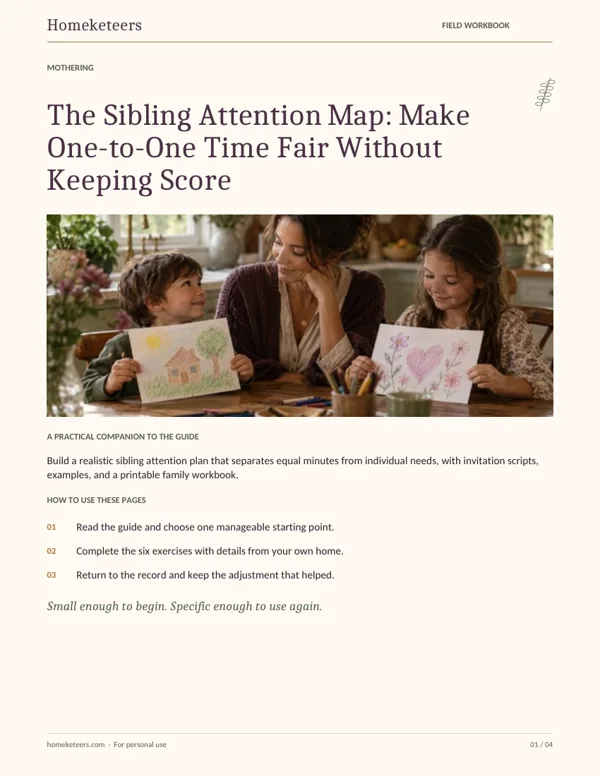
A child can be surrounded by people all day and still want a few minutes when nobody else is competing for the conversation. In a busy family, that request often arrives as interruption: an argument during a sibling's story, a sudden demand while you help with homework, or a question just as you begin another task. One-to-one time can help you create a clearer invitation to connection. It does not require identical activities or an elaborate outing.
The Homeketeers Sibling Attention Map distinguishes three things: shared family time, individual connection, and necessary care. A child with a medical appointment may receive more care time that week. That does not mean the other child's need for ordinary conversation has vanished. Equally, necessary care should not be described as a special reward. Separate these categories before trying to make the calendar look mathematically fair.
Ask for the kind of attention each child wants
Offer two manageable choices: a walk together or a short kitchen project; sitting beside them while they draw or listening to one story from their game. A teenager may prefer parallel activity rather than sustained eye contact. A younger child may want a predictable ten-minute invitation. Do not require a meaningful conversation as the price of receiving time. Quiet companionship can be the activity.
Make the invitation specific: 'Would you like ten minutes after lunch to show me what you are making?' Avoid 'We should spend more time together,' which creates an expectation without a place to put it. Let a child decline and offer another time. If they repeatedly decline, ask whether the timing, activity, privacy, or pressure is the problem. Do not turn refusal into an accusation of ingratitude.
Find existing windows before creating new outings
Look for a school pickup with only one child present, a grocery errand, a quiet breakfast, or a younger child's nap. Count only time when your attention is genuinely available. Ten minutes while answering work messages may not be the invitation you intended. When you cannot set the phone aside because you are on call, explain the limit and choose another window if possible.
Write the beginning and end. Predictability matters more than an ambitious duration you cannot sustain. If an interruption occurs, acknowledge it and name a restart: 'We have four minutes left. We will finish after I handle this.' Do not promise a future session you already know cannot happen. A smaller reliable invitation is more useful than a large plan repeatedly postponed.
Give siblings an understandable boundary
Tell the household whose turn it is and what the other children can do. For younger children, another responsible person may need to provide supervision; individual time does not justify leaving a child unsafe. If no other caregiver is available, use a shared-room arrangement with a clearly defined focused activity, and explain that privacy will be limited.
Avoid using one-to-one time as a prize for good behavior. A child who is struggling should still be able to seek connection, while ordinary limits remain in place. The invitation does not cancel consequences for harmful behavior. You can say, 'I want time with you, and we still need to repair what happened with your sister.' Both statements can be true.
An illustrative week with uneven needs
One child has two appointments; another has a school project; a teenager wants to discuss a friendship. Their mother schedules a ten-minute drawing session, a short grocery errand with the project child, and a private walk with the teenager. Appointment transport remains in the care column. The calendar is uneven in minutes, but each child has a recognizable invitation and the mother knows what she has promised.
If a child asks why a sibling gets more time, explain the situation without disclosing private details. 'Your brother needs help with appointments this week. You also have your own time with me on Saturday.' Ask what feels missing. Sometimes the complaint is about uninterrupted listening, not duration. Keep a record of invitations and cancellations, not a scoreboard measuring who is most loved.
Protect the parent's capacity too
Use a maximum weekly commitment you can maintain. One adult cannot provide unlimited focused time while carrying every household task. If another caregiver is present and appropriate, let them make their own invitations rather than requiring you to design and supervise every session. The goal is a pattern of available relationships, not a new management project for one mother.
Review after two weeks. Ask each child what they enjoyed and what made the time difficult. Adjust one part, such as the activity or location, rather than extending every session. You are building a family practice that respects individual people. Fairness here means responding to real needs with honest limits, not producing an equal-minute chart that ignores how your family actually lives.
Your Homeketeers field workbook: put this guide into practice
Use the Sibling Attention Map for two weeks before making a permanent calendar. The worksheet separates invitation, necessary care, and shared time. Keep private notes out of a public family display. The visible calendar needs only a name, a time, and an activity; sensitive explanations can stay in the parent's workbook.
Name the invitation
Write one activity the child actually wants, a realistic duration, and two possible times. Ask rather than assume. Record whether they prefer talking, making, moving, or simply being beside you. A reluctant answer is useful information. Reduce the pressure or change the invitation instead of turning the time into a lesson about gratitude.
Separate care from connection
Record appointments, homework support, and daily care in one column. Put freely chosen individual time in another. This prevents a sibling's care needs from disappearing inside a supposedly equal schedule. It also helps you see whether a child receives plenty of help but little uncomplicated attention. Do not show private care details to siblings.
Make interruption plans
Write who supervises other children, what the interruption threshold is, and how you will resume if needed. Emergencies come first. Ordinary requests can wait when another responsible person can help. If supervision is unavailable, design an activity that works safely in a shared room. Call it focused time rather than promising privacy you cannot provide.
Use an honest fairness script
Prepare a short response for comparison: 'Different needs take different kinds of time. Your invitation is still important, and we will keep the time we agreed.' Leave space for the child's answer. Ask what specifically felt missing. Do not use a sibling's difficulties to silence another child's feelings or disclose something the sibling expected you to keep private.
Record cancellation and repair
Note a missed session and the next available repair time. Count repeated cancellations as a planning problem, not evidence that the child is demanding. If the same window fails twice, change the window before adding another promise. Tell the child the new plan plainly. A record keeps you from relying on memory when the week becomes crowded.
Ask for feedback without grading affection
Use two questions: 'What part did you like?' and 'What would make this easier next time?' Accept an answer about the activity rather than expecting a declaration of closeness. Record one change you can make. Keep the parent's capacity on the page too, so a successful practice remains something you can sustain.
Keep a record that tells you what actually changed
After two weeks, compare invitations offered, invitations kept, and the child's feedback. Look for a pattern such as quieter conversation during a walk or fewer conflicts about whose turn it is. Do not claim the map caused every behavioral change. Children and circumstances change for many reasons. Keep what is working and remove a window that repeatedly fails. The useful outcome is a clear, dependable invitation for each child, alongside realistic care and supervision. You do not need an equal number of photographs, outings, or minutes to demonstrate that each child matters.