A Samhain ancestor spread can bring structure to a season of memory. This six-card layout asks what you want to carry forward, what may be ready to loosen its hold, and what small intention could take root through winter. It works with tarot or oracle cards, and it can be adapted to family stories or a meaningful book.
This is a reflective practice, not a way to verify contact with the dead or predict the future. Read each card as a symbol that helps you notice your own memories, values, and choices. You are free to stop, skip a position, or change the wording if a question feels wrong for you.
The six positions
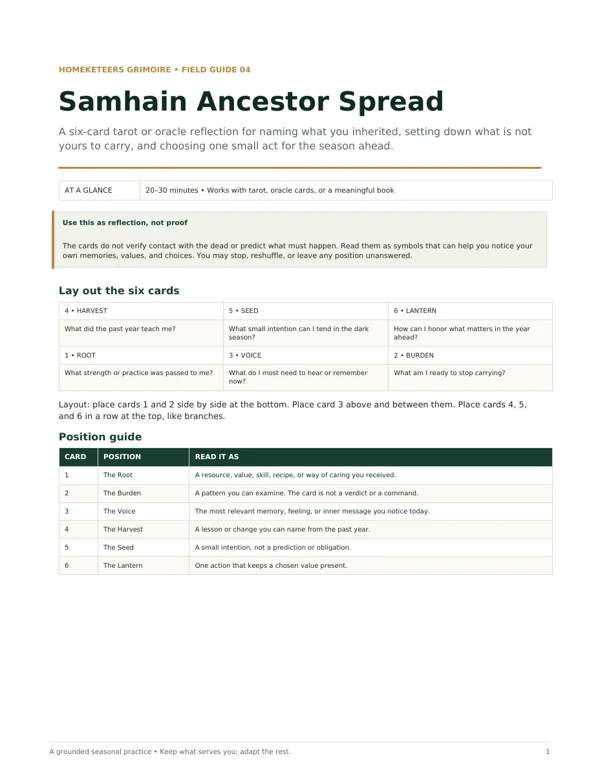
- 1. The Root: What strength, practice, or value from those before me can I recognize?
- 2. The Burden: What pattern am I ready to stop carrying or examine more closely?
- 3. The Voice: What do I most need to remember or hear today?
- 4. The Harvest: What did the past year teach me through experience?
- 5. The Seed: What small intention could I tend in the darker season?
- 6. The Lantern: What action could honor what matters in the year ahead?
Place cards 1 and 2 side by side at the bottom. Put card 3 above and between them. Place cards 4, 5, and 6 in a row across the top, like branches. The spread is a simple visual map, not a hierarchy of importance.
Read the spread without pressure
- Settle. Sit comfortably. Take three easy breaths. Decide whether you are thinking about ancestors, chosen family, beloved dead, or your own family history.
- Set an intention. Use grounded words such as: ‘Show me a perspective worth considering.’ You do not need to call anyone in.
- Shuffle and draw. Turn one card at a time. Read the position aloud before you look at the card.
- Record your first response. Write the card name and the first image, memory, or feeling that comes up. Do this before consulting a guidebook.
- Look for relationships. Compare Root and Lantern: how could a strength become a present action? Compare Burden and Seed: what might become possible if you set down a pattern? Then notice what the Voice card adds.
- Choose one step. Pick an action small enough to do and within your control. A card does not obligate you to make a major decision.
- Close. Put the deck away, drink water, and return to an ordinary activity. If a card feels frightening or overwhelming, pause and orient to the room around you.
A completed reading
Read the morning after a silent supper, one reader drew the Nine of Pentacles for Root and thought of Grandma Ruth’s garden. The Five of Wands reversed appeared for Burden and brought up the family arguments the reader keeps trying to referee. The Star in Voice suggested rest and hope, echoing the word enough from the prior evening. Eight of Pentacles marked Harvest: learning by practicing. Page of Cups in Seed suggested restarting a sketchbook. Six of Cups in Lantern suggested teaching the children Ruth’s peach recipe next summer. The action chosen was modest: buy an inexpensive sketchbook and set aside twenty minutes on Sunday.
When a card is difficult or unclear
- A frightening image is not proof of danger or a message from the dead. Stop the reading if you need to.
- If you use reversals, choose a consistent approach. You might read a reversed card as inward, blocked, delayed, or beginning to loosen. It does not need to be a warning.
- If you do not own a deck, open a meaningful book to six different pages and use the first line you notice as a reflection prompt.
- For a secular version, rename the positions Roots, Pattern, Present, Lesson, Intention, and Action. Use family stories, journaling, or personal history instead of divination.
Keep a record worth returning to
Write the date, deck, card names, first responses, and one chosen action. If the reading includes details about living relatives, keep it private. Revisit the Seed in spring only if doing so is useful. Ask what you tried and what you learned, not whether a card was ‘right.’
The free Samhain Ancestor Spread Reading Log includes a clear spread layout, all six position meanings, a complete sample reading, a structured one-reading record, a chosen-action tracker, and a five-year check-in. It gives the reading a practical endpoint instead of repeating the same blank prompts.
This spread is a reflection step for Samhain Ritual: Honoring the Thin Veil and A Silent Supper for Remembrance. You can also use it on its own. For a table with clear boundaries around who and what is remembered, see A Samhain Remembrance Table for the Ancestors You Choose.
Treat the spread as a reflection tool
Some readers approach ancestor work spiritually; others use the word for family history, chosen elders, or the people who shaped their lives. You can choose the frame that fits. The cards are not evidence that a particular person is communicating, and they do not overrule your judgment. If an interpretation seems to tell you to take a risky action, pause and consider the real-world facts first.
For a grounded reading, write down what you notice before consulting a guidebook. A color, posture, remembered recipe, or immediate reaction can tell you what the card brings up in your own mind. The guidebook can add vocabulary, but it does not have to outrank your lived context. There may be several plausible readings. Choose the one that helps you make a thoughtful, safe, and proportionate choice.
Read the positions in pairs
The Root and Lantern create a practical bridge between inheritance and action. If Root points toward patience, Lantern might ask how you can practice patience in a specific conversation. If Root suggests resourcefulness, the action could be to repair something, share a skill, or ask for help. The point is not to imitate an ancestor exactly; it is to decide what value you want to express now.
The Burden and Seed pair asks what space might open when a pattern changes. A Burden card is not a diagnosis or accusation. It can prompt a question about habits, expectations, or roles you have accepted. The Seed should stay small enough to tend: schedule a short walk, make a recipe, set a boundary, or start a sketchbook. A small action can be reviewed; a sweeping promise can become another source of pressure.
The Voice and Harvest positions help connect present reflection to the year you just lived. The Voice does not need to be interpreted as a literal message. It may reflect what you already know but have not said aloud. Harvest can include a hard-earned lesson, a skill you practiced, or something you chose to stop doing. Read the two together, then see whether they suggest an action that belongs to you.
A sensible approach to reversals
Readers use reversals differently. If you read reversed cards, choose a method before the reading: blocked, inward, delayed, developing, or loosening. A reversed card can also be read upright if that is how you work. Avoid turning reversal rules into certainty about danger, punishment, illness, or what a dead person wants. The position and your context matter more than a rigid keyword list.
Keep your record useful next year
Record the date, deck, position, card, first response, and action you chose. If you want to compare readings, preserve the original entry rather than rewriting it to match what happened later. In spring, revisit only the Seed and Lantern: what did you try, what changed, and what do you want to keep? This is a reflection on your choices, not a test of whether divination predicted the future.
If the reading includes sensitive family details, keep the log somewhere private. You can record the card names without recording the full story. You can also destroy or delete a reading later. A private practice still belongs to you, even after the ritual is over.
When a card brings up strong feelings
Stop when you need to. Put the deck away, name a few ordinary objects in the room, and return to a familiar activity. You do not need to finish all six positions. If a particular card repeatedly causes distress, leave it out of this spread or change its question. A spiritual tool should not require you to override your boundaries.
The Ancestor Spread Reading Log includes a layout diagram, a completed interpretation, a position-by-position record, a specific action tracker, and a five-year check-in. Its purpose is to help you read with care and remember what you chose, not to fill pages for the sake of journaling.
When you draw a card that seems to match a complicated relationship, resist the urge to collapse the person into one meaning. A card can help you remember a particular act of care and still recognize harm elsewhere. You may name what you want to carry forward while refusing to repeat a pattern. The Root is not an instruction to idealize the past, and the Burden is not a verdict on you.
If you read with a partner or family member, each person can interpret their own cards. Do not pull a card for another guest or announce what their reading means unless they invite you to. Even a well-meant interpretation can feel invasive when someone is grieving. The spread works privately, and there is no group-sharing requirement.
You may also replace the ancestor language with a focus on chosen lineage: artists, mentors, friends, organizers, or elders whose work shaped you. Credit the living people whose teachings you use, ask permission before sharing their private words, and keep the reading centered on what you will do with the influence you received.