Many people observe Samhain as a time for remembering the dead and turning toward the darker half of the year. Some describe the veil between the living and the dead as thin. You do not need to hold a particular belief to use this practice. It can be a deliberate act of remembrance: setting out one object, saying a name, and giving yourself a few minutes to notice what the year has changed.
Samhain (pronounced SOW-in) began as a Gaelic festival in Ireland and Scotland, marking the end of harvest and the turn toward winter. Modern Pagans observe it as part of the Wheel of the Year. The ritual below is an open, home-based adaptation, not a reconstruction of a closed tradition. If Samhain is not part of your tradition, you can keep the structure and call it a seasonal remembrance.
Decide whom you are honoring
Blood relatives are not required. You may remember chosen family, a friend, teacher, community elder, beloved pet, or ancestors whose names were never recorded. You are never obligated to honor someone who harmed you. A boundary is part of the ritual: leave a name off the table, honor a specific quality without praising the whole relationship, or choose someone else entirely.
Choose one or two details that make the remembrance real. A recipe card, a phrase someone used, the way a dog waited at the door, a favorite song, or a small object can carry more meaning than a long list of names. If an object belongs to someone else or includes another person’s private story, ask before displaying or sharing it.
What to gather
- A stable table, shelf, or tray with room to move safely around it.
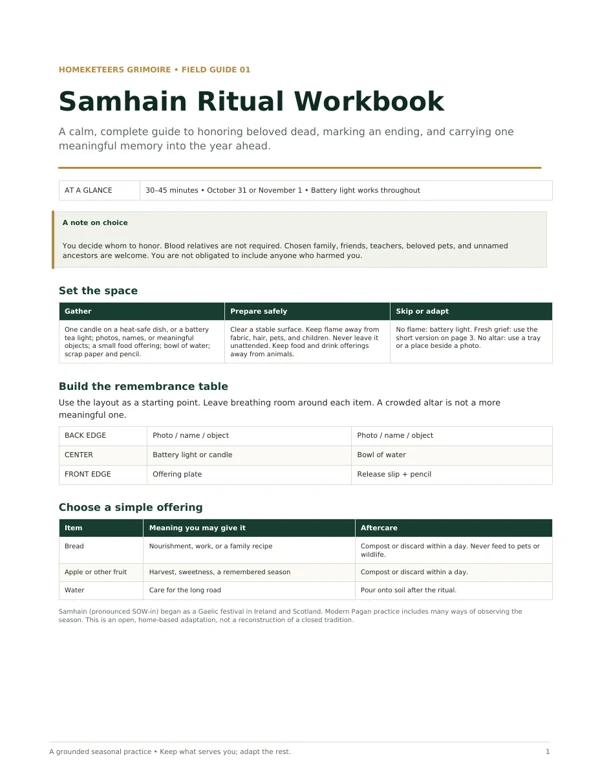
- One candle on a heat-safe dish, or a battery tea light.
- Photos, written names, or small objects connected to the people or animals you choose.
- A small offering such as bread, apple, or water, placed out of reach of pets and children.
- A bowl of water, scrap paper, and a pencil for the smoke-free release.
- The Samhain Ritual Workbook, if you want the ceremony and record pages beside you.
Prepare a remembrance table
Clear and wipe the surface. Arrange the photos, names, and objects first, leaving a little space around each. Put the offering plate in front and the water bowl to one side. Keep liquids away from photographs and paper. A copied photograph protects the original. If children or pets share the home, use a high, stable shelf and battery light.
Before you begin, choose your stopping point. Decide whether you want to sit for five minutes, read only one name, or use the short version. If a fresh loss makes a longer ritual too much, do not force it. A small remembrance can be complete.
The ritual, step by step
- Ground. Sit or stand with both feet supported. Take three comfortable breaths. Let the exhale lengthen naturally; do not force a breath pattern.
- Open. Switch on the tea light or light the candle. Say: ‘At the turning of the year, I make room for memory. Those I love who have gone before are welcome in my thoughts tonight.’ Change the words or keep silence.
- Name. Speak each chosen name slowly. After each, share one true detail: what they cooked, a phrase they used, a way they made you feel, or an ordinary moment you still carry. For unnamed ancestors, you might say: ‘Those whose names were not kept, you are remembered here.’
- Offer. Place the food or water on the table. If words help, say: ‘For what nourished us, for what grew, and for the care that carries us.’ The offering is symbolic; no one needs to consume it during the ritual.
- Release. Write one role, worry, or expectation that this year has finished for you. Fold the paper and place it in the water. Say: ‘What has ended, I allow to end.’ This is a smoke-free step. Do not burn the paper.
- Listen. Sit quietly for five minutes, or for as long as feels steady. Notice a memory, sensation, word, song, or nothing in particular. There is no required sign and no correct response.
- Close. Say: ‘Thank you for this time of remembering. I return to the present with care.’ Switch off the light or extinguish the candle. Name one ordinary next action, such as drinking water or making tea.
A completed example
Ruth hummed hymns while canning peaches. My high-school art teacher told me my sketches ‘had nerve.’ Biscuit waited by the door every day at 3:15. I released the belief that I have to hold every family tradition together alone. During the quiet, the smell of peaches came back and the word enough stayed with me.
Aftercare and adaptations
If it is safe, you may leave offerings out overnight. Remove them within a day; compost or discard food, keep it away from animals, and pour water onto soil. Do not leave a candle burning unattended. Put photographs and fragile objects away safely when the table is no longer in use.
- No flame allowed: Use a battery tea light. The words and memory do not depend on a flame.
- Fresh loss: Use only Open, Name, and Close. Let the rest wait for another day or another year.
- With a partner: Take turns naming. Each person controls how much they share.
- Complicated family: Honor a lesson, recipe, or place rather than the person. You may leave the table empty for someone you do not want to include.
- Short on energy: Switch on a light, speak one name and one memory, then close. That is a complete practice.
The next day, the Samhain Ancestor Spread can offer a structured reflection on what surfaced. Treat it as a way to explore memory and choice, not as proof of contact or a demand to act. Keep the notes private if they include another person’s story.
Use the free Samhain Ritual Workbook for the altar layout, the spoken ceremony, a completed example, an aftercare checklist, and a year-to-year remembrance record. It is designed to guide the practice, not to assign you more reflection work.
Why a small ritual can hold more than a grand one
A seasonal ritual is useful when its parts help you do something you actually need. A table gives memory a place to land. A spoken line gives the moment a beginning. A chosen ending helps you return to the rest of your night. You can remove any part that does not support you. The work is not in making the altar look perfect or in producing a profound feeling on demand.
If you are honoring more than one person, do not rush through a list. Pick one memory for each person and keep it concrete. ‘She was wonderful’ is true but broad; ‘she peeled apples into one long ribbon and let us steal the pieces’ gives a memory shape. For a pet, name a habit or a favorite place. For someone whose name was lost, you can recognize that lives and care existed even when records did not preserve them.
Choose what belongs on your table
A remembrance table is not an invitation to put every family relationship on display. It can hold one person, one chosen family member, or no photo at all. You might place a copied recipe, a leaf from a remembered place, or a written quality you want to keep alive in your own actions. If your history includes harm, you may remember the land, food, language, or person who offered care without turning the harmful relationship into something safe or admirable.
Privacy matters when other people are present. Do not ask guests to explain a photo, disclose a painful history, or share a message they would rather keep private. If you want to share pictures of the altar online, make sure everyone represented has agreed. A personal ritual does not become more valid because it is public.
A practical way to close the evening
After the last name, give yourself a transition back to the present. Turn on the room lights, wash your hands, put away the pencil, or make a cup of tea. If the ritual brings up strong emotion, reduce the task to one ordinary step: sit beside someone you trust, drink water, or move to a familiar room. No one has to finish a written reflection before they are allowed to stop.
In the morning, you can review what you wrote without treating every word as an instruction. Keep a memory that feels nourishing; let a difficult feeling remain a feeling. If something needs action, choose one concrete next step that is yours to take. The ritual is a container for remembrance, not a demand to solve family history in one night.
For the release step, choose something within your control. ‘I release the person who hurt me’ can imply a task you may not be ready to do. A smaller and more honest line might be, ‘I am finished pretending that this did not affect me,’ or ‘I am allowed to stop being the family messenger.’ You do not need to release grief, love, or memory. The ritual can mark a boundary without asking you to feel differently.
If the water bowl feels too symbolic or messy, fold the slip and set it beside the bowl instead. After the ritual, recycle or discard it privately. The essential step is naming an ending, not dissolving ink. Choose a method that is safe for your home and comfortable for you.
Some households prefer to make the remembrance table before the ritual and leave it in place for a few days. If you do, decide when it will be cleared and who will handle the objects. Others may prefer a tray that is assembled and put away the same evening. Both approaches work; choose the one that fits your home, your privacy, and the people who share the space.