Children can see the season change: the sun sets earlier, bare branches appear, and mornings feel colder. A Samhain lantern night gives a family a way to notice that change together, remember someone they love if they wish, and welcome winter without making darkness frightening or grief compulsory.
This home-based activity is flexible. A child may decorate, listen, draw, watch, or step away. They do not have to name someone who died or tell a personal story. A ritual should make room for children, not ask them to manage an adult’s feelings.
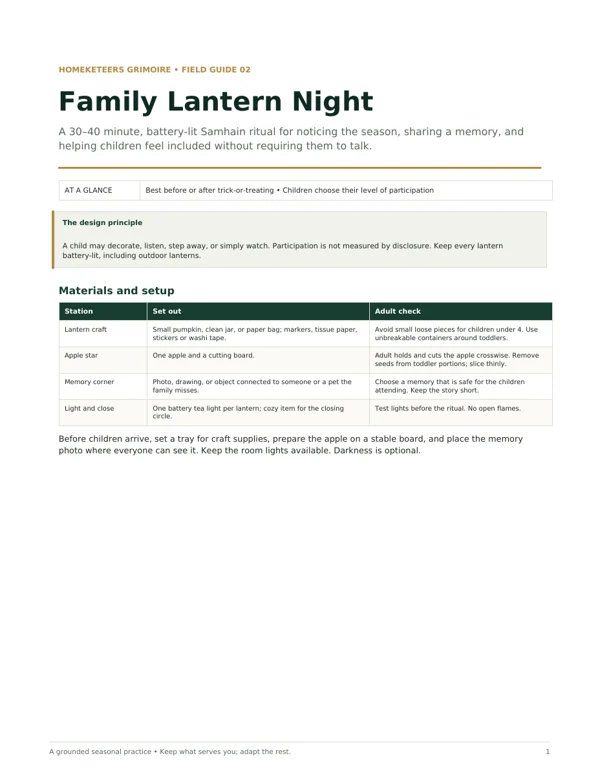
Gather the materials
- A small pumpkin, clean glass jar, or paper bag with a folded top for each lantern.
- Battery tea lights. Use battery lights indoors and outdoors for this family activity.
- Markers, tissue paper, stickers, or washi tape. For children under four, avoid small loose decorations and choking hazards.
- One apple, a stable cutting board, and a knife used by an adult only.
- A photo, drawing, or object for a person or pet the family misses. A seasonal memory can stand in if no one wants to focus on death.
- A familiar cozy item or activity for the closing moment.
The 35-minute lantern night
- Make the lanterns, 10 to 12 minutes. Invite each child to decorate with something they want to remember from the lighter part of the year: a trip, garden, new friend, favorite meal, or ordinary sunny day. Say: ‘Your lantern can show anything you want to carry into winter.’
- Find the apple star, 3 to 4 minutes. An adult cuts the apple across its middle to reveal the seed pattern. Say: ‘The apple keeps a star inside. We can carry a little light through darker days too.’ Share the slices safely.
- Switch on the lights, 3 to 4 minutes. Dim the room only if everyone is comfortable. Turn the lanterns on one at a time. Say: ‘Our lights are here. We are here together.’ Room lights can stay on.
- Tell one short story, 8 minutes. Hold up the photo or drawing. An adult shares one warm, concrete memory. Invite the children to add something, draw instead, listen, or pass. Do not turn the moment into a test of memory.
- Say goodnight to summer, 4 minutes. At a window or on the porch, say together: ‘Goodnight, summer. Thank you for the light and growing things. Hello, winter. We will keep small lights close.’
- Close, 3 minutes. Back inside, each person may name or point to one cozy thing ahead: cocoa, a book, snow, a favorite blanket, or a movie. Lanterns may stay on as night-lights if they are safe for the child’s age and the product instructions allow it.
Talking clearly about death
When a child asks what happened, answer the question in simple, honest language. Avoid phrases such as ‘went to sleep’ or ‘went away,’ which can make ordinary sleep or separation frightening. The right amount of detail depends on the child and the circumstances. You can answer briefly and let them ask more.
- Around ages 3 to 5: ‘Grandpa died. His body stopped working. We remember him by telling stories.’ Keep the explanation short and concrete.
- Around ages 6 to 8: Answer what they ask, then pause. ‘I don’t know’ is an honest answer when you do not know.
- Around ages 9 to 12: Invite questions and mixed feelings. Let them choose a story, write a note, or help decide how the memory is shared.
Age ranges are guides, not rules. Children vary in language, development, culture, and experience. If a child looks overwhelmed, stop the story, bring the lights up, and stay present. The family ritual still counts.
A completed family example
Mason, 7, drew the lake from a summer trip. Ivy, 4, covered her jar with orange tissue paper. The family remembered Pepper, a cat who used to sleep in the laundry basket. The adult told one short story. Mason added that Pepper would want the basket to stay warm. Ivy listened and passed on speaking. For winter, Mason chose snow forts and Ivy chose hot cocoa.
Make it fit your household
- If there is a recent loss, shorten the ritual. Turn on the lanterns and sit together without a story.
- If a child wants no memory photo, decorate with a favorite place, pet, or seasonal image.
- If children are different ages, give the older child a real choice and a young child a concrete role such as choosing the light color.
- If the evening is already busy, complete only the lantern and one closing sentence. No one has to finish every step.
Use the free Family Lantern Night printable for a full-size lantern design area, an optional remembrance drawing frame, large-print closing words, an age-aware host guide, and a family example. It is a use-it-at-the-table resource, not a page of questions for children to fill out.
For a longer remembrance ritual, continue with Samhain Ritual: Honoring the Thin Veil. If your household wants to remember together around a meal, see A Silent Supper for Remembrance. Both practices make passing and adapting part of the plan.
Keep the activity child-led and sensory-aware
The point is to give children a safe way to notice a seasonal change. It is not to produce a photograph-worthy craft or a perfect family moment. Let them choose whether to use markers, paper, stickers, or nothing at all. Some children enjoy a dim room; others find darkness or flickering lights uncomfortable. Keep room lighting steady if that works better. A battery tea light can be switched off, covered, or replaced by a simple paper decoration.
Prepare the craft before inviting children to the table. Put out only the materials they can use independently and keep scissors, blades, hot glue, and small parts with an adult. A clean jar can break if dropped, so choose a plastic cup or paper bag for a child who is still learning to handle glass. If decorating a pumpkin, let an adult do all cutting and remove the carved top before children get close.
Make the apple step safe and meaningful
The apple is a visual moment, not a test of symbolism. An adult should steady the cutting board and slice the apple sideways through its middle to reveal the seed pattern. Cut away from hands, then serve thin slices appropriate to each child’s age and eating ability. Young children should eat seated and supervised. If an apple is not safe or welcome in your household, show a picture of a star, draw one on paper, or skip this step altogether.
Avoid telling children they must eat an offering or that the apple contains a magical message. The invitation can stay simple: ‘There is a star-shaped pattern inside. Let’s see what the middle looks like.’ Children can enjoy the discovery without sharing a belief about what it means.
If you are remembering someone who died
An adult can tell one short story that is safe for the children present. A useful memory is specific and ordinary: a grandparent’s lopsided pancakes, a dog who waited by the door, or a neighbor who waved from the garden. Keep the story to a few minutes. If the child asks a direct question, answer honestly in language they can understand, then leave room for another question later.
Do not promise that the person can hear the child or is watching over them unless that is a belief you hold and want to share. You can say, ‘Some people believe that. I think we can remember them by telling stories.’ You can also say you are not sure. This leaves room for children to have their own thoughts as they grow.
Make passing a real option
Children may copy adult language without feeling ready to talk. Give them a clear pass phrase such as ‘I want to listen’ or let them point to a small pass card. Do not circle back and ask them to speak after they pass. If they leave the room, let a trusted adult follow if appropriate. If a child becomes distressed, stop the story and switch to an ordinary comfort activity. The lantern can simply become a night-light; it does not have to finish the ritual.
For families with older children, invite them to help shape the format. They might choose which memory is shared, set the duration, or decide whether the closing words feel right. Giving a teenager a real choice can make the ritual feel like a shared practice rather than a performance designed by adults.
Use the ritual in a busy Halloween evening
The best time is the time your family has. Some households may do this before trick-or-treating while everyone is calm. Others may prefer the next morning, when costumes are put away and the house is quieter. You can spread the ritual over two days: make the lantern one evening, tell the story another day. Nothing about the practice requires October 31 or a particular hour.
The Family Lantern Night guide includes a practical run-of-show and a family example so you can see how a child might participate without speaking. Print the page you need, place it with the craft supplies, and adapt the activity to your child’s ages, sensory needs, and family beliefs.
For a child who communicates without speech, offer choices through pictures, pointing, or an assistive communication device. A lantern design can be selected by color, touch, or choosing between two pre-cut decorations. Do not make eye contact, spoken answers, or sitting still a condition of participating. A child can also leave the activity and return later without needing to explain.
For blended or chosen families, ask caregivers which names and stories are comfortable to include. Children may have different relationships to the same person, and a family member may be living while another has died. You can keep the activity centered on the season, a beloved animal, or a happy memory. The children do not need to carry a shared family interpretation.
A ritual does not have to be repeated every year to matter. If lantern night feels like too much this time, skip it. If the children ask to make lanterns again in the spring, let the memory grow beyond a calendar date. The useful part is the shared attention and the freedom each person has to decide what to bring to it.